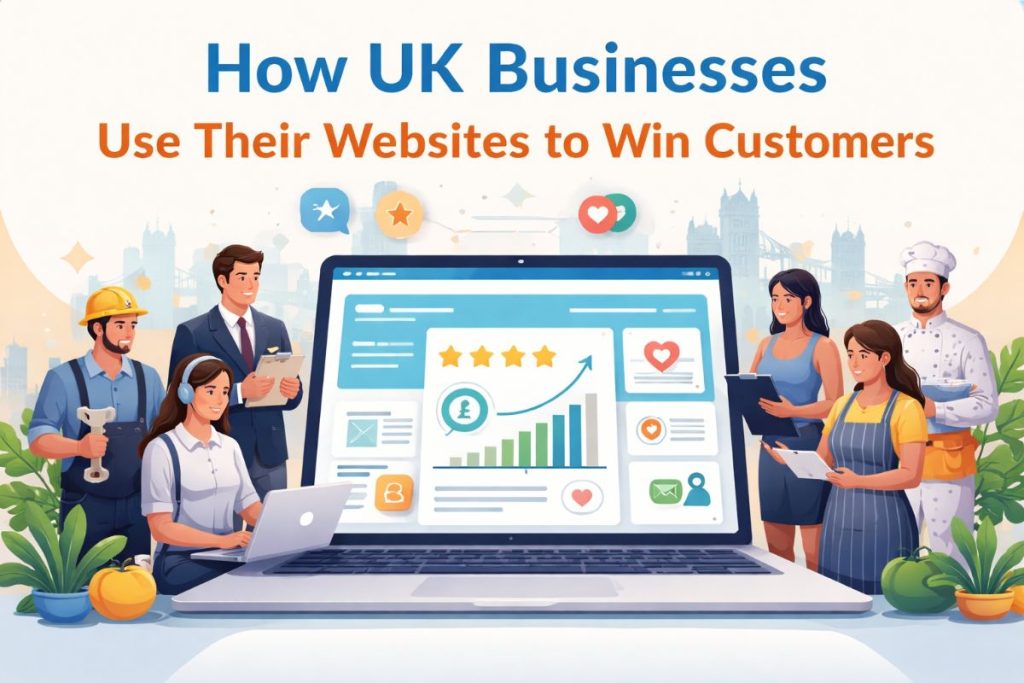
A business website is primarily a decision-support tool rather than a sales pitch. Across UK industries, websites help customers assess credibility, reduce uncertainty and confirm suitability before making contact or purchasing. While sectors differ in emphasis, the core function of a website remains consistent.
- Websites reduce perceived risk more than they persuade.
- Industry context shapes which information matters most.
- Trust signals often outweigh design or copy volume.
- Clear next steps matter more than promotional language.
In practice, trade, legal, fitness, retail and hospitality websites differ in presentation, but rely on the same behavioural principles.
This article analyses how UK businesses across multiple industries use their websites to attract and convert customers. It is written for business owners, marketers, publishers and editors assessing how websites function in real decision-making contexts.
The key insight is that effective websites prioritise reassurance, clarity and usability over persuasion. While industry-specific expectations exist, underlying customer behaviour remains consistent. This analysis focuses on observable usage patterns rather than individual outcomes or performance claims.
Context and Relevance
For most UK customers, a website is not the first point of contact. Discovery often happens through search results, recommendations, social platforms, or offline word of mouth. By the time a visitor lands on a website, they are usually looking to confirm whether the business is legitimate, suitable and worth engaging with.
A common misunderstanding is assuming that stronger claims or more content will automatically improve results. In many cases, the opposite is true. Websites that perform well tend to prioritise structure, relevance and clarity over volume.
If you’re planning a rebuild with that in mind, see Web Design UK.
These patterns appear consistently when reviewing live business websites across sectors and regions.
Many of the issues discussed here overlap with wider problems around business visibility and poor online presence, which often limit enquiries before a website’s quality even comes into play.
For a local benchmark of how Essex business sites compare, see the 2025 Essex Business Website Report.
Methodology and Data Transparency
This article is based on qualitative reviews of UK small and medium business websites across multiple industries.
The analysis considers:
- Page structure and content hierarchy
- Information prioritisation and visibility
- Common conversion pathways
No traffic data, revenue figures, or performance guarantees are implied. Observations reflect common and recurring patterns rather than edge cases. Industry practices naturally vary depending on business size, region and operating model.
Trades and Home Services
What Customers Look For
Customers visiting trade and home service websites typically seek reassurance. They want evidence that the business is legitimate, experienced and operating locally. Reviews, certifications, insurance details and examples of completed work are often more influential than detailed service descriptions.
What the Website Is Mainly Used For
These websites function as credibility checks. Their role is to confirm that the business is real, reachable and competent before a customer makes contact by phone or form.
One Common Mistake
Legal and Professional Services
What Customers Look For
Visitors to legal and professional service websites look for authority, clarity and reassurance. Credentials, areas of expertise and plain-English explanations help reduce anxiety around complex or sensitive matters.
What the Website Is Mainly Used For
One Common Mistake
Fitness and Wellness Businesses
What Customers Look For
Customers want relatability and tangible outcomes. They look for signs that the service works for people like them, including testimonials, environment visuals and practical information about sessions or memberships.
What the Website Is Mainly Used For
Fitness and wellness websites support motivation and comfort. They help visitors decide whether the environment, approach and culture feel suitable.
One Common Mistake
Retail and E-commerce

What Customers Look For
Retail customers prioritise clarity, speed and confidence. Transparent pricing, delivery information, returns policies and clear product descriptions are essential.
What the Website Is Mainly Used For
One Common Mistake
Hospitality and Leisure
What Customers Look For
Visitors want to visualise the experience. They look for atmosphere, location context, menus, availability and practical details such as opening times or booking processes.
What the Website Is Mainly Used For
Hospitality websites support planning. They help customers decide when to visit, what to expect and how to book.
One Common Mistake
A frequent issue is prioritising imagery over usability. When essential information is difficult to find, users often abandon quickly.
Education and Training Providers

What Customers Look For
Prospective students and parents look for credibility, outcomes and clarity. They want to understand who the course is for, what they will gain and whether the provider is recognised or experienced.
What the Website Is Mainly Used For
One Common Mistake
Financial Services and Accountancy
What Customers Look For
Customers seek reassurance, compliance and trust. They look for qualifications, regulatory clarity and simple explanations of complex financial topics.
What the Website Is Mainly Used For
One Common Mistake
Recruitment and HR Services
What Customers Look For
Visitors want clarity around process, specialism and credibility. Employers look for sector knowledge, while candidates look for transparency and opportunity.
What the Website Is Mainly Used For
Recruitment websites support matchmaking. They clarify roles, expectations and whether engagement is worthwhile for either side.For local discovery, Google Business Profile (GBP) is often the first visibility layer.
One Common Mistake
Property and Estate Agencies
What Customers Look For
Property customers want trust, local knowledge and accuracy. They look for clear listings, transparent processes and realistic information.
What the Website Is Mainly Used For
One Common Mistake
Many sites prioritise visual design over usability. When search, filters, or contact details are unclear, users disengage quickly.
Manufacturing and B2B Services
What Customers Look For
Buyers seek capability, reliability and scale. They want to know whether the business can meet specifications, timelines and compliance requirements.
What the Website Is Mainly Used For
One Common Mistake
Creative and Media Businesses
What Customers Look For
Customers want proof of capability and fit. They look for examples of work, clarity on approach and signals that the business understands their needs.
What the Website Is Mainly Used For
One Common Mistake
Healthcare and Private Clinics
What Customers Look For
Patients seek trust, safety and reassurance. They look for qualifications, treatment clarity and an understanding tone.
What the Website Is Mainly Used For
One Common Mistake
Technology and SaaS Businesses

What Customers Look For
Visitors want clarity on use cases, benefits and compatibility. They look for simple explanations of what the product does and who it is for.
What the Website Is Mainly Used For
One Common Mistake
Cross-Industry Website Usage Comparison
| Industry | Primary Customer Need | Website’s Main Role | Common Pitfall |
|---|---|---|---|
| Trades | Trust and legitimacy | Credibility confirmation | Weak trust signals |
| Legal | Authority and clarity | Validation before contact | Over-complex language |
| Fitness | Relatability and comfort | Motivation and reassurance | Missing practical detail |
| Hospitality | Experience visualisation | Visit planning | Hidden information |
What All Successful Websites Have in Common
Across industries, effective websites consistently share the same characteristics:
- Clear purpose for each page
- Information ordered by customer priority
- Obvious, simple next steps
- Trust signals placed early rather than buried
Rather than persuading aggressively, these sites focus on reducing doubt.
What Does Not Change Between Industries
Customer behaviour remains largely consistent regardless of sector. Visitors scan first, seek reassurance second and only engage deeply once trust is established. While content emphasis varies, structure and intent do not fundamentally change.
Key Findings (For Media and Sharing)
- Websites primarily reduce customer uncertainty.
- Trust signals matter more than volume of content.
- Industry differences affect emphasis, not structure.
- Over-complexity consistently harms usability.
Commercial Intent Containment: Interpreting These Patterns
For businesses considering improvements to their websites, these patterns suggest that effectiveness is less about adding features and more about alignment with customer intent. Understanding why visitors arrive and what they need to confirm helps prioritise clarity, structure and usability over redesigns driven by trends.
Industry-Agnostic Patterns in Website Reviews
Across industries, similar patterns emerge when reviewing business websites, including those built by web design agencies in Essex and across the UK.
And when those patterns come down to build quality (speed, structure, maintainability), that’s where Web Development Essex becomes relevant.
Location and sector influence presentation, but expectations around clarity, trust and ease of use remain consistent.
Internal Context and Further Reading
- See broader research on UK business website behaviour
- Related analysis: sector-specific website benchmarks
- Supporting explainer: how customers evaluate business websites
Conclusion
UK businesses use their websites less as direct sales tools and more as confidence-building assets. While industries differ in focus, the underlying purpose remains the same: reduce uncertainty and support decisions. Recognising this helps businesses align their websites with how customers actually behave.
If you’re reviewing how your website supports your business goals, these patterns offer a useful starting point.