
The best web design in Essex is defined by performance rather than appearance. High-performing websites focus on clear structure, fast loading speeds, strong SEO foundations and user-friendly navigation.
Key factors that define the best web design in Essex include:
- Clear website structure and navigation
- Fast page speed and mobile optimisation
- SEO-ready content and page hierarchy
- Strong user experience and conversion flow
- Clear messaging and service explanation
While these principles apply broadly, real-world differences become clearer when comparing how businesses implement them across Essex. For instance, variations in structure and SEO foundations are noticeable in areas like Brentwood and Chelmsford, as well as Basildon and Billericay.
Businesses that prioritise these elements are usually better positioned to generate enquiries, support search visibility and compete more effectively online.
This ultimate guide explains how to choose the best web design in Essex, what makes a high-performing website, typical costs and how to improve your current site. It is designed for business owners looking to generate more leads through better website performance. The key takeaway is that structure, speed and clarity matter more than design alone. This guide focuses on practical insights rather than individual agency reviews.
When businesses search for “best web design Essex,” they usually think they are looking for the most visually impressive website or the agency with the strongest portfolio. In reality, that assumption is one of the biggest reasons websites fail to perform.
You can see this clearly in comparisons like Romford vs Grays business websites, where visually decent sites still underperform due to weak structure and unclear user flow.
This pattern is also visible in more detailed comparisons such as Colchester vs Southend web design quality, where differences in structure, usability and SEO foundations become more apparent across similar types of businesses.
The idea of “best” in web design is often misunderstood because it is judged visually rather than functionally. A website can look modern, clean and professionally designed, but still fail to generate leads, rank in search engines, or convert visitors into customers. This disconnect is extremely common across Essex, where many businesses invest heavily in design without understanding performance.
For a broader breakdown of how these differences appear across the county, see our complete guide to best web design in Essex, which explains the core performance factors behind high-performing websites.
The best web design in Essex is not defined by how a website looks at first glance. It is defined by how it performs under real conditions.
In some areas, this gap is more visible than others, as shown in Colchester vs Southend website quality, where differences in usability and SEO structure stand out.
Similar variations can be seen across other areas, including Harlow vs Epping website performance, where consistency, structure and ongoing optimisation play a key role in long-term results.
That means how it loads on mobile, how quickly users can find information, how clearly services are explained and how easily a visitor can take action.
A high-performing website reduces effort for the user. It answers questions before they are asked, guides users through a logical journey and removes friction at every step. A poorly performing website does the opposite. It forces users to think, search and wait.
This difference is subtle but powerful.
Most users will not consciously analyse a website. They will not say, “this site has poor structure” or “this navigation is inefficient.” Instead, they will simply leave. That behaviour is what defines performance.
So when we talk about the best web design in Essex, we are not talking about aesthetics. We are talking about efficiency, clarity and usability. Businesses that understand this consistently outperform those that do not.
Why Web Design Is Now the Most Important Asset for Essex Businesses
Over the past few years, the role of a business website has changed significantly. It is no longer just a place where customers can find contact details or basic information. It has become the primary decision-making tool for potential customers.
In Essex, competition has increased across almost every industry. Whether you are a tradesperson in Basildon, a consultant in Chelmsford, or a service provider in Colchester, your website is now competing directly with others in your area.
This becomes clearer when comparing local markets such as Brentwood vs Chelmsford web design standards, where competition levels and overall website quality expectations are noticeably higher.
Most customers will:
- Search online before making a decision
- Compare multiple businesses
- Form an opinion within seconds
This means your website is often your first and most important impression.
If your website is slow, unclear, or difficult to use, users will not wait. They will leave and visit a competitor. This behaviour is not intentional or emotional. It is simply how users interact with digital environments.
The implication of this is significant.
Your website is no longer a supporting asset. It is a core part of your business. It influences how customers perceive you, how they trust you and whether they choose to contact you.
In many cases, it determines whether you win or lose business before any direct interaction takes place.
For many Essex businesses, the website is now part of the sales process before a conversation ever happens. It is central to business performance.
The 5 Core Elements of High-Performing Web Design (Deep Breakdown)
1. Structure: The Foundation of Everything
Structure is the most important and most overlooked aspect of web design. It determines how information is organised, how users navigate the site and how easily they can find what they are looking for.
A well-structured website feels intuitive. Users do not need to think about where to click or how to move through the site. Everything follows a logical flow.
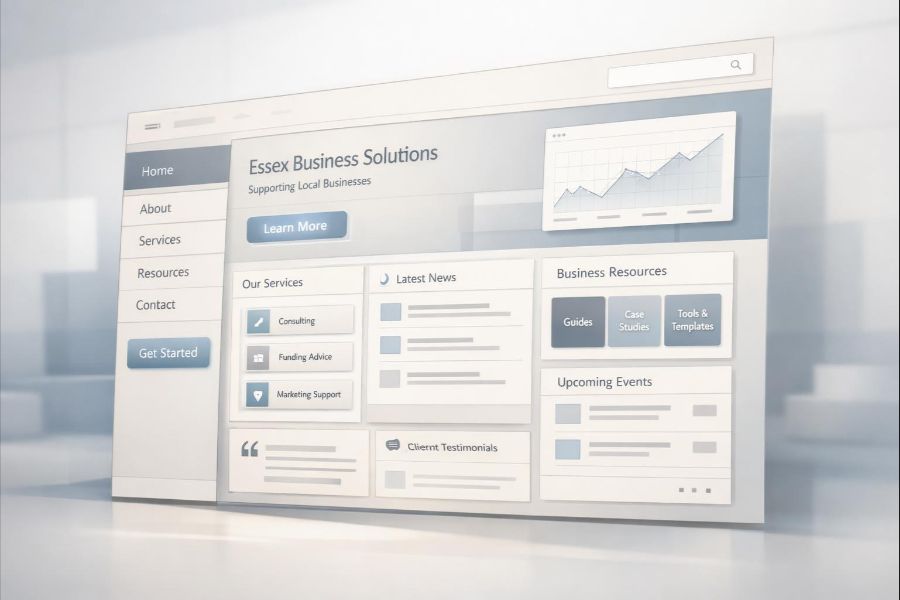
A poorly structured website creates friction. Users hesitate, backtrack, or leave entirely.
In Essex, many websites are built with a design-first approach. This means the layout is created visually, without fully considering how the site will function. The result is often a homepage that looks strong but a deeper structure that feels inconsistent.
A strong structure should:
- Group services logically
- Provide clear navigation paths
- Support both users and search engines
It should also scale. As the business grows and adds more content, the structure should be able to accommodate it without becoming confusing.
Structure is not visible in the same way design is. But it is felt in every interaction.
2. Speed: The Silent Performance Driver
Speed is one of the most critical factors in website performance, yet it is often underestimated. Users expect websites to load quickly, especially on mobile devices.
If a page takes too long to load, users will leave. They will not wait and they will not return.
In Essex, many websites suffer from performance issues due to:
- Large, unoptimised images
- Heavy design elements
- Poor hosting or outdated builds
These issues are often introduced during the design process, where visual impact is prioritised over performance.
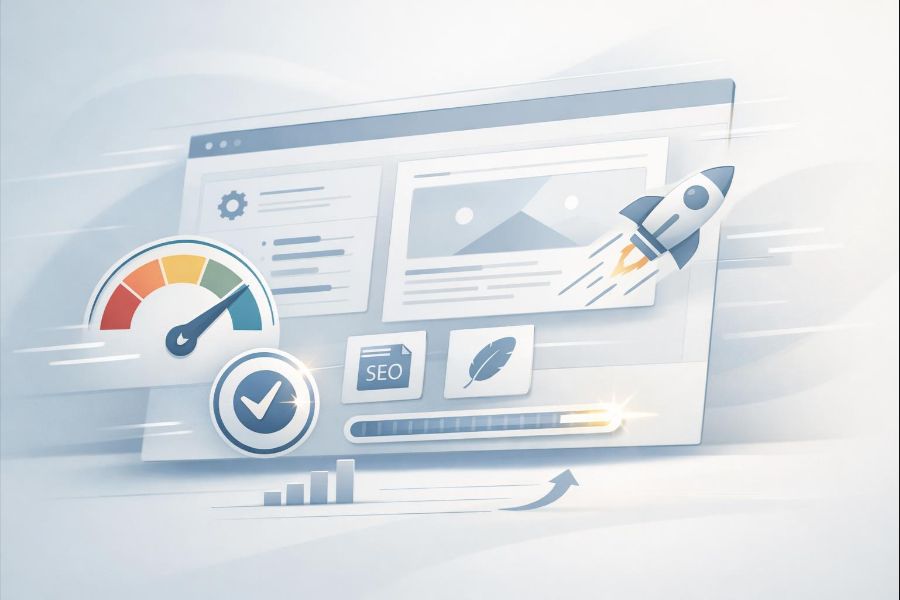
Fast websites create a smoother experience. Users can navigate quickly, access information without delay and interact with the site without frustration.
Slow websites create friction at every step.
Speed is not just a technical factor. It directly impacts:
- User engagement
- Conversion rates
- Search rankings
A fast website is a competitive advantage.
3. User Experience (UX): Reducing Friction
User experience is about how easy it is for someone to use your website. It includes everything from navigation and layout to readability and interaction.
A strong user experience removes friction. It makes it easy for users to understand what the business offers, how it can help them and what they should do next.
A weak user experience does the opposite. It creates confusion, increases effort and reduces engagement.

In Essex, many websites provide information but do not guide users effectively. Users are left to interpret the content and decide what to do.
High-performing websites guide users step by step:
- Clear headings
- Logical sections
- Visible calls to action
This reduces cognitive load and improves conversion rates.
4. SEO Foundations: Built for Visibility
A website must be built with search engines in mind from the beginning. SEO is not something that can be added later without significant effort.
Strong SEO foundations include:
- Clear heading structure
- Proper page hierarchy
- Internal linking
- Relevant content
Without these elements, a website may look good but struggle to rank.
Across Essex, many websites lack these fundamentals. They are designed visually but not structured for search visibility.
This creates a gap between appearance and performance.
5. Content & Messaging: The Conversion Layer
Content is what communicates value to the user. It explains what the business does, how it works and why it matters.
Clear content builds trust. It reduces uncertainty and helps users make decisions.
Weak content creates confusion. Users may not fully understand the service or its benefits.
In Essex, many websites list services but do not explain them in detail. This is a missed opportunity.
Strong content should:
- Be clear and direct
- Focus on user needs
- Support the overall structure
Why Many Essex Websites Look Fine but Underperform
Most business websites in Essex are not failing because they look bad.
In many cases, they appear modern, functional and professionally designed.
But performance tells a different story.
Across multiple local comparisons, a consistent pattern emerges. Underperformance is usually caused by a combination of small structural issues rather than one obvious flaw.
This is particularly evident in comparisons like Basildon vs Billericay website quality, where similar businesses achieve very different outcomes based on structure, clarity and user experience.
These often include:
- Poor page structure and unclear navigation
- Slow loading speeds, especially on mobile
- Weak or inconsistent SEO foundations
- Content that lists services but does not explain them clearly
From a business owner’s perspective, the site works.
From a user’s perspective, it creates friction.
Users hesitate. They search for information. They lose momentum.
And in many cases, they leave.
This is the key difference between a standard website and a performance-driven one.
A standard website presents information.
A performance-driven website guides users, reduces effort and encourages action.
This difference is subtle, but it has a direct impact on enquiries, conversions and long-term results.
One of the most common mistakes is evaluating a website based on how it looks rather than how it works.
A visually strong site can still underperform if the structure, speed and clarity are not in place.
High-performing websites are not defined by appearance alone. They are defined by how efficiently they help users move from interest to action.
How to Choose the Best Web Design Company in Essex
Choosing a web design company is one of the most important decisions a business can make, yet it is often approached in the wrong way.
Most businesses evaluate agencies based on:
- Portfolio appearance
- Price
- First impression
While these factors matter to some extent, they are not reliable indicators of performance.

A visually strong portfolio does not guarantee that the websites perform well in real-world conditions. Many agencies are capable of producing attractive designs, but far fewer are capable of building websites that actually convert, rank and scale.
The key is to shift your evaluation criteria.
Instead of asking:
“Do their websites look good?”
You should be asking:
“Do their websites work effectively?”
This means looking deeper into:
- Structure
- Speed
- User journey
- SEO foundations
A good web design company will prioritise these elements from the beginning. They will not treat them as optional extras or future improvements.
How Much Does Web Design Cost in Essex? (Real Breakdown)
Pricing is one of the most misunderstood areas of web design.
Businesses often assume:
- Higher price = better quality
- Lower price = poor quality
In reality, pricing reflects:
- Agency positioning
- Scope of work
- Level of strategy
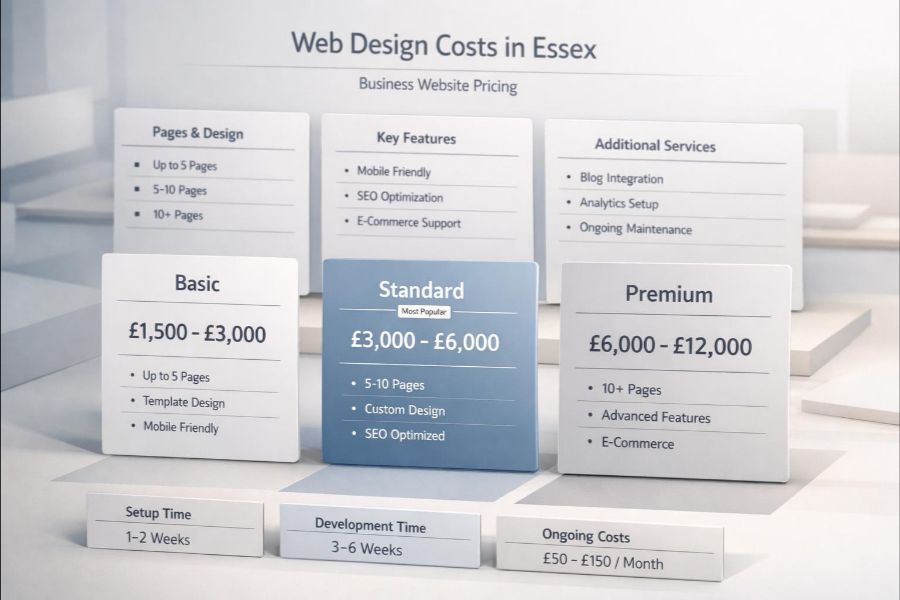
Typical Price Ranges in Essex
£500 – £1,500 (Low-End)
What you get:
- Basic template website
- Limited customisation
- Minimal SEO
Common issues:
- Poor structure
- Slow performance
- Limited scalability
Suitable for: very small businesses with minimal needs
Not suitable for: growth-focused businesses
£1,500 – £4,000 (Mid-Range)
What you get:
- Custom design elements
- Better structure
- Basic SEO setup
Quality varies significantly in this range.
Some agencies deliver strong value.
Others focus on design without performance.
Suitable for: small to medium businesses
Must be evaluated carefully
£4,000 – £10,000+ (High-End)
What you get:
- Strategy-led design
- Strong structure
- Performance focus
- SEO-ready build
This is where more strategy-led and performance-focused projects often sit.
Suitable for: serious businesses focused on growth
The Real Cost (What Most People Miss)
The cost of a website is not just what you pay upfront.
The real cost includes:
- Lost leads from poor performance
- Low conversion rates
- Weak SEO visibility
A cheap website that underperforms is more expensive in the long run than a well-built website that generates results.
What Makes a Website "Worth It"
A website is worth its cost if it:
- Generates consistent enquiries
- Ranks in search results
- Supports business growth
If it does not do these things, it is not an investment.
It is an expense.
Essex Web Design: Town-Level Reality (Important Insight)
From analysing multiple towns across Essex, a clear pattern emerges.
Different areas show different levels of website quality.
For example, in Romford vs Grays web design comparisons, variation in structure, usability and overall performance is clearly visible even within similar industries.
Higher Consistency Areas:
- Chelmsford
- Colchester
- Epping
These areas tend to have:
- Better structured websites
- Stronger SEO foundations
- More consistent performance
Mixed Performance Areas:
- Basildon
- Harlow
- Grays
These areas show:
- Greater variation in quality
- More “average” websites
- Less consistency
Design-Heavy Areas:
- Southend-on-Sea
- Brentwood
These areas often prioritise:
- Visual presentation
- Branding
But sometimes at the expense of:
- Performance
- clarity
Why This Matters
This creates an opportunity.
If your website:
- Is better structured
- Loads faster
- Communicates clearly
You immediately outperform most competitors.
The Role of Strategy in Web Design
A website without strategy is just a collection of pages.
A strategic website:
- Has a clear goal
- Guides users toward action
- Supports SEO
Strategy determines:
- Structure
- Content
- User journey
Without it, design becomes guesswork.
Questions You Should Ask Before Hiring
Before choosing a web design company, ask:
- How do you approach website structure?
- How do you ensure fast performance?
- How do you design for conversions?
- How do you incorporate SEO?
The answers will tell you everything.
What a High-Performing Essex Website Looks Like (In Practice)
A high-performing website:
- Loads quickly
- Has clear navigation
- Explains services clearly
- Guides users toward action
It does not need to be complex.
It needs to be effective.
How SEO Supports Better Web Design in Essex
How Search Engines Evaluate Website Quality
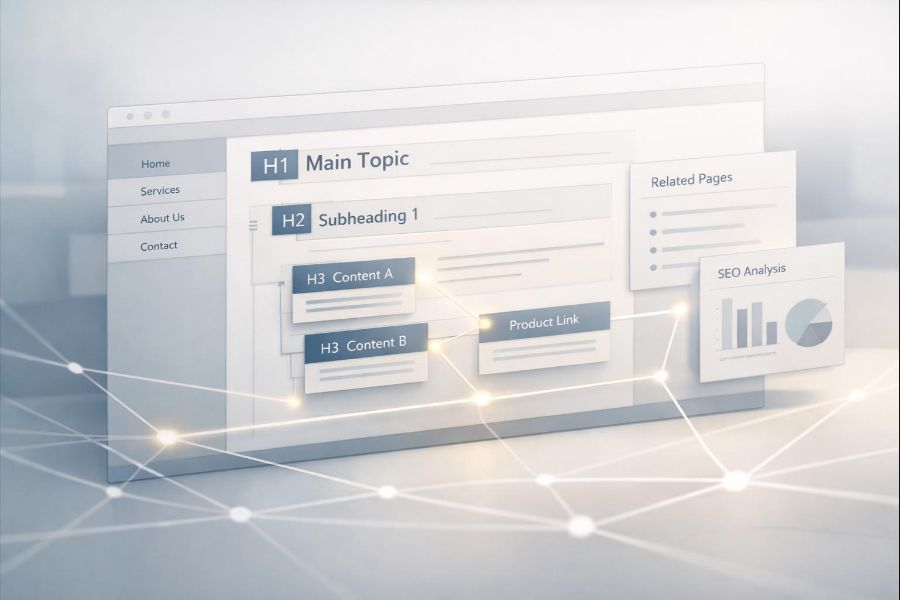
Search visibility is a key part of website performance, especially for service-based businesses in Essex.
However, SEO is often misunderstood. It is not driven by design alone and it is not something that can simply be added properly after a website is finished.
Search engines rely on signals that help them understand whether a page is useful, relevant and easy to interpret.
These signals include:
- Clear page structure
- Relevant content
- Logical heading hierarchy
- Internal links between related pages
- Mobile usability and page experience
This is why web design and SEO are closely connected.
A website may look professional, but if the structure is unclear, the headings are poorly organised, or pages are isolated from each other, search performance can suffer.
Strong web design gives search engines and users the same thing: clarity.
Topical Depth and Local Relevance
For a competitive search term like “web design Essex”, one page alone is rarely enough to build strong authority.
A stronger approach is to support the main guide with related content that explores the topic in more detail.
This might include town-level comparisons, pricing guides, website improvement articles, or explainers around SEO and conversion.
Each supporting page adds context.
For example, comparison articles such as Brentwood vs Chelmsford, Basildon vs Billericay, Romford vs Grays, Colchester vs Southend and Harlow vs Epping help show how website quality varies across Essex.
This builds local relevance.
When supported by detailed comparisons such as Brentwood vs Chelmsford, this type of content helps build stronger topical relevance and reinforces authority across Essex.
It also helps users explore the subject more deeply, instead of landing on one broad page and reaching a dead end.
The goal is not to publish more content for the sake of it.
The goal is to build useful coverage around the topic, so the website becomes a stronger resource for Essex businesses researching web design.
Why Internal Linking Matters
Internal linking connects related pages together.
This helps users move through the site naturally and helps search engines understand the relationship between different pieces of content.
For example, a main guide about web design in Essex should link to relevant comparison articles and supporting resources.
Those supporting articles should also link back to the main guide where appropriate.
This creates a clear authority structure.
Instead of isolated pages competing separately, the website becomes a connected content network.
Good internal linking also improves user engagement.
If someone reads about website structure in one section, they should have a natural route to a deeper article on local website comparisons or performance issues.
This keeps the journey useful and controlled.
Content Structure and Search Intent
Search engines need to understand what a page is about.
Users need to understand it quickly.
That is why content structure matters.
A strong page should use clear headings, short sections and logical ordering. It should answer the questions users are likely to have when searching for “best web design Essex”.
These questions often include:
- What makes a good website?
- How much does web design cost?
- How do I choose a web design company?
- What affects rankings and enquiries?
- What should I improve first?
When a page answers these questions clearly, it is better aligned with search intent.
Length can help, but only when it adds useful depth.
A long page filled with repetition is weaker than a clear, structured page that answers the topic properly.
For Essex businesses, the practical takeaway is simple: SEO should be built into the structure, content and user journey from the start.
It should not be treated as an afterthought.
How Long It Takes to Rank
Realistically:
12 – 24 weeks (if executed properly)
Depends on:
- Competition
- Internal linking
- On-page optimisation
How to Improve Website Performance (Structure, Speed & SEO)
Improving website performance is primarily about how a site is built and maintained, rather than how it looks.
For many Essex businesses, performance issues come from structural gaps, slow loading speeds and unclear content rather than design alone.
Addressing these areas creates a stronger foundation before any conversion improvements are considered.
In practice, this often starts with structure.
If users cannot navigate the website easily, or if services are not clearly organised, even strong content will struggle to perform. Reviewing how pages are grouped, how navigation works and how information flows is often one of the most effective first steps.
Speed is another key area.
Many websites lose potential enquiries simply because they load too slowly, particularly on mobile devices. Optimising images, reducing unnecessary design elements and ensuring the site is built efficiently can make a noticeable difference.
Content clarity also plays a central role.
In many cases, services are listed but not fully explained. Expanding key pages to clearly describe what is offered, how it works and who it is for helps reduce uncertainty and improves user confidence.
Internal linking is often overlooked.
Connecting related pages helps users explore the site more easily while also supporting search visibility. For example, linking from a main service page to more detailed explanations or related topics creates a more cohesive experience.
Rather than focusing on large redesigns, many improvements come from refining what already exists.
Small changes, applied consistently, tend to have the greatest impact over time.
A Practical Way to Approach Improvements
For businesses unsure where to start, a simple approach is to review the website from a user’s perspective.
This can involve asking a few key questions:
- Is it immediately clear what the business offers?
- Is the site easy to navigate without thinking?
- Does the website load quickly on mobile?
- Are key pages easy to find and understand?
If any of these are unclear, they represent opportunities for improvement.
In many cases, addressing these fundamentals leads to better engagement, stronger enquiry rates and more consistent performance overall.
Why Incremental Improvements Matter
Website performance rarely improves through a single redesign.
Instead, it develops gradually through consistent refinement.
Websites that perform well are usually those that have been improved over time. Content has been expanded, structure has been clarified and performance has been optimised in stages.
This creates a cumulative effect.
Each improvement builds on the last, leading to a more effective and resilient website.
In contrast, websites that are left unchanged tend to lose effectiveness as user expectations evolve and competitors improve.
For Essex businesses, the opportunity is not just to build a better website, but to continuously improve it.
Transition to Conversion
These improvements focus on how the website functions and performs.
However, performance alone is not enough.
Once users arrive on the site, the next step is ensuring they take action.
Conversion: Turning Website Visitors Into Enquiries
Even a well-structured, fast and SEO-optimised website will underperform if it does not guide users towards action.
Businesses looking to improve both performance and conversion can explore structured solutions such as professional web design services in Essex, where strategy, SEO and user experience are developed together from the start.
Conversion is what turns traffic into real business results. It focuses on how users think, what they need to feel confident and how easily they can take the next step.
This is where many otherwise well-built websites fall short.
Why Many Websites Fail to Convert
Attracting visitors to a website is only part of the process. For many Essex businesses, the real challenge is turning that traffic into enquiries.
A website can rank well, receive consistent visitors and still generate very little business.
In many cases, the issue is not visibility. It is what happens after the user arrives.
Most websites are built to present information. They describe services, outline what the business does and provide contact details.
But they do not actively guide users.
When a user lands on the page, they are left to figure things out for themselves.
They ask questions internally:
- Is this relevant to me?
- Can this business solve my problem?
- What should I do next?
If the answers are not immediately clear, hesitation builds.
And hesitation often leads to exit.
The Role of Clarity, Trust and Direction
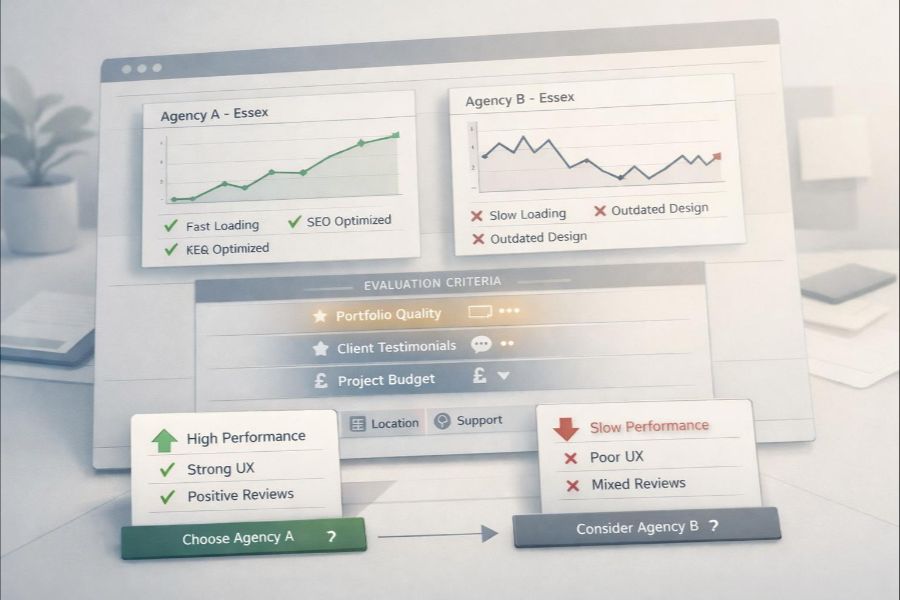
High-performing websites make the user experience feel simple.
This comes down to three core elements: clarity, trust and direction.
Clarity allows users to understand the business quickly. Within a few seconds, they should know what the business offers, who it is for and how it can help them.
Trust is built through consistency and detail.
Users rarely rely on a single claim. Instead, they form an impression based on multiple signals across the page, such as:
- Testimonials or reviews
- Clear contact information
- Consistent layout and structure
- Well-explained services
Direction is what turns understanding into action.
Even if a user understands the service and trusts the business, they may still hesitate if the next step is unclear.
Clear calls to action remove this uncertainty.
These should be visible, well-placed and repeated at natural decision points within the page.
Reducing Friction in the User Journey
Friction refers to anything that slows the user down or creates confusion.
It often appears in subtle ways:
- Pages that load slightly too slowly
- Sections that are unclear or overly complex
- Navigation that requires extra effort
- Key information that is difficult to find
Individually, these issues may seem minor.
But combined, they significantly reduce usability and conversion rates.
Users tend to compare multiple websites quickly. The one that feels easiest to use is usually the one they engage with.
Reducing friction involves simplifying the experience.
This includes:
- Keeping layouts clean and predictable
- Using clear headings and spacing
- Avoiding unnecessary design elements
- Making navigation obvious
- Ensuring fast performance across devices
The goal is not to impress users with complexity.
It is to make the experience feel effortless.
Mobile Experience and User Behaviour
Mobile usage now dominates website traffic in many industries.
This changes how users interact with websites.
On mobile, attention spans are shorter and patience is lower. Small issues become more noticeable.
A slow-loading page feels slower.
A cluttered layout feels more confusing.
A poorly placed button becomes harder to use.
High-performing websites are designed with mobile use in mind from the beginning.
This includes:
- Fast loading speeds on mobile networks
- Simple, easy-to-scan layouts
- Buttons that are easy to tap
- Minimal friction when moving between sections
When these elements are in place, the experience feels natural.
When they are not, users leave quickly.
What High-Converting Websites Do Differently
The most effective websites are not necessarily the most visually impressive.
They are the ones that feel the easiest to use.
They guide users through a clear path, reduce uncertainty at each step and make the next action obvious.
In practice, this often means:
- Clear messaging from the first screen
- Logical flow from section to section
- Consistent calls to action
- Strong alignment between user intent and page content
These elements create momentum.
Users move forward without needing to stop and think.
That is what ultimately drives conversion.
A high-converting website does not rely on persuasion alone.
It relies on clarity, structure and ease of use.
Final Strategic Summary
To win in Essex web design:
You need:
| Area | What Matters Most |
|---|---|
| Structure | Clear pages, logical navigation, scalable layout |
| Speed | Fast loading, especially on mobile |
| SEO | Strong headings, internal links, useful content |
| UX | Simple journeys and low friction |
| Conversion | Clear CTAs, trust signals, strong messaging |
Final Conclusion
The best web design in Essex is not defined by visual style alone.
Strong websites are structured clearly, load quickly, explain services well and guide users towards action.
For Essex businesses, the opportunity is not just to look better online. It is to build a website that works harder, lasts longer and supports real business growth.
That starts with structure, speed, clarity and a proper foundation from day one.