
Business websites in Colchester and Southend-on-Sea differ primarily in structure, consistency and performance rather than visual design. While both towns have active commercial environments, Colchester businesses typically demonstrate stronger SEO foundations, clearer navigation and more reliable usability, resulting in more effective overall website performance.
Key differences at a glance:
- Stronger structure and navigation clarity in Colchester websites
- More consistent page speed and technical performance
- Better SEO implementation and internal linking
- Clearer user journeys and calls to action
- Greater consistency across pages and layouts
Concise comparison:
Colchester websites generally deliver more consistent and performance-driven results, while Southend-on-Sea websites show wider variation in quality and usability.
This article compares local business websites in Colchester and Southend-on-Sea using performance-focused criteria including structure, speed, SEO, UX and content clarity.
For a broader breakdown of what defines strong web design in Essex, see our complete guide, which explains the core performance factors behind these differences.
It is designed for business owners evaluating their website or planning improvements. The key insight is that website quality is driven by consistency and execution rather than design alone. One limitation is that findings are based on a representative sample rather than the entire market.
Context & Relevance
Colchester and Southend-on-Sea are two of the most prominent commercial hubs in Essex, but they represent very different business environments.
Colchester is historically established, with a strong mix of professional services, education-linked businesses and growing digital adoption. There is a noticeable trend toward structured, content-driven websites.
Southend-on-Sea, on the other hand, has a more diverse and tourism-influenced economy. Businesses range from local services to hospitality and retail, with a wider range of digital maturity levels.
At first glance, websites in both towns appear comparable.
A similar pattern appears in the Brentwood vs Chelmsford website comparison, where visual quality often masks deeper structural differences.
Most include:
- Modern layouts
- Service listings
- Contact functionality
But this surface-level similarity does not reflect actual performance.
When you move beyond the homepage and start interacting with these websites – navigating deeper pages, using them on mobile and attempting to take action – differences become clear.
Some websites feel structured and easy to use.
Others feel slightly inconsistent, slower, or less intuitive.
This is where quality becomes measurable.
Methodology & Data Transparency
This comparison is based on:
- 20 local business websites
- 10 from Colchester
- 10 from Southend-on-Sea
Each site was evaluated using:
- Manual UX walkthroughs
- Mobile-first testing
- Speed and responsiveness checks
- Structural and SEO analysis
Evaluation criteria included:
- Page load speed
- Navigation structure and hierarchy
- SEO fundamentals (headings, metadata, indexing readiness)
- User journey clarity
- Mobile usability
- Content clarity and depth
- Trust signals
- Technical build quality
- Internal linking
- Scalability
Limitations:
- Limited sample size
- Industry variation
- Some websites may have been recently updated
This is a pattern-based comparison, not a ranking of individual businesses.
Core Comparison
1. Website Structure & Navigation
Structure is the foundation of website performance and it is one of the most consistent differences between Colchester and Southend-on-Sea.
Colchester websites tend to show stronger structural planning. Navigation menus are clearer, page hierarchy is more defined and services are grouped logically. Users can move through the site without confusion and information is organised in a predictable way.
There is a sense of intention behind how the site is built.
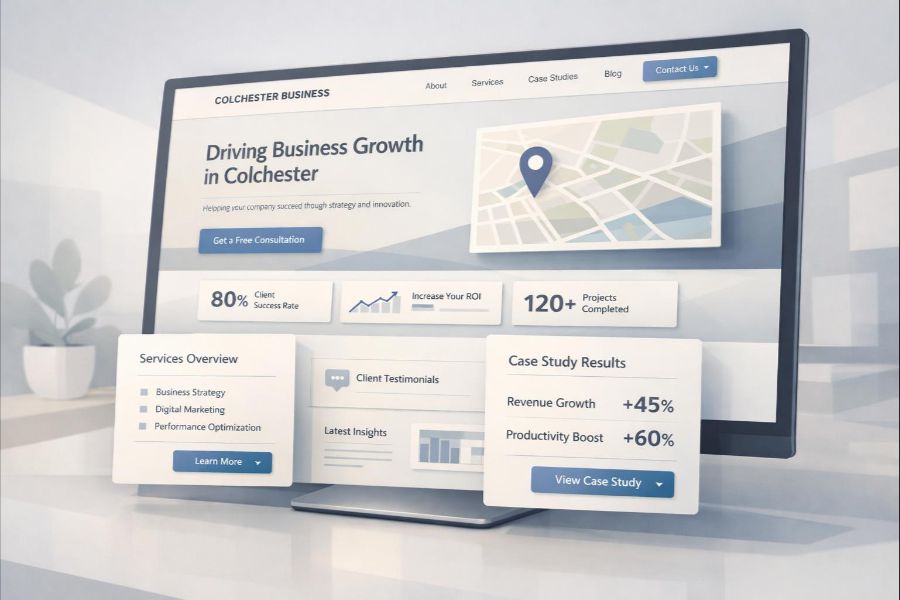
There is a sense of intention behind how the site is built.
Southend-on-Sea websites often show more variation. Some are well-structured, but many feel less organised. Navigation can be basic and deeper page hierarchy is not always clear. Services may be listed, but not grouped effectively.
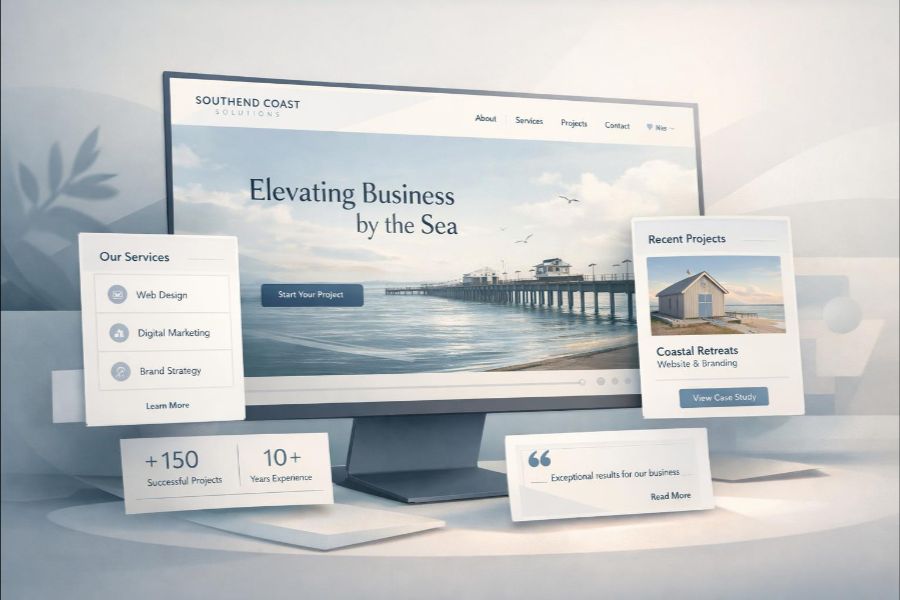
This creates friction.
This type of structural friction is also visible in the Basildon vs Billericay small business website comparison, where clarity and organisation directly affect how users move through the site.
Users can still navigate the site, but they have to think more.
Takeaway:
Colchester websites demonstrate stronger structural clarity and navigation consistency.
2. Page Speed & Performance
Speed is one of the most important factors in website performance.
Colchester websites tend to show more consistent loading speeds. Pages generally load quickly and feel responsive, particularly on mobile devices. This is often due to cleaner builds and better optimisation.
Southend-on-Sea websites show a wider range of performance. Some load quickly, but others are noticeably slower. This is often linked to:
Heavy design elements
Unoptimised images
Outdated builds
Even small delays can significantly impact user behaviour.
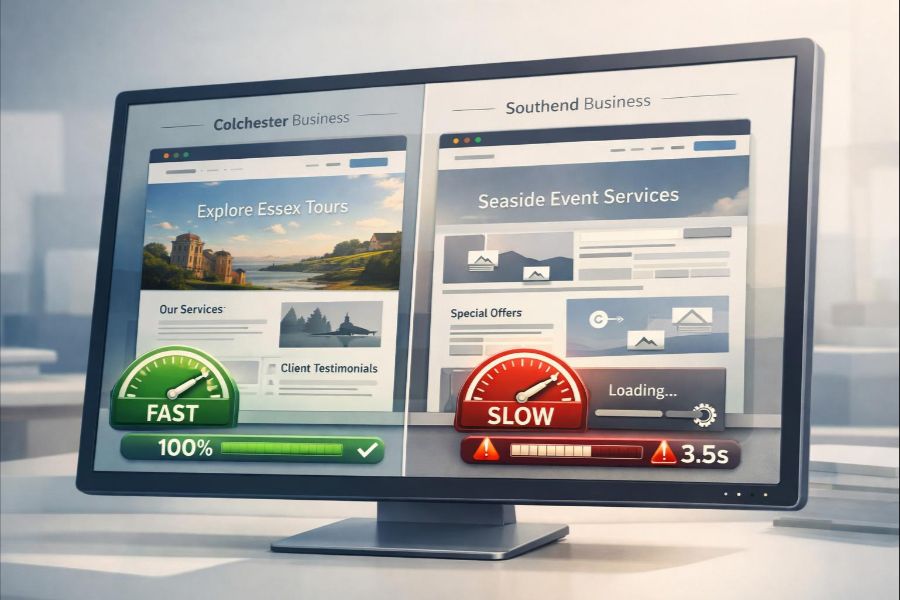
Users are more likely to leave slower sites.
Takeaway:
Colchester websites generally provide more consistent speed and performance.
3. SEO Structure & Indexing Readiness
SEO is critical for visibility, yet it is often inconsistently implemented.
Colchester websites tend to show stronger SEO fundamentals. Page structures are clearer, headings are used effectively and content is easier for search engines to interpret.
Southend-on-Sea websites often show inconsistencies. Common issues include:
- Poor heading hierarchy
- Missing metadata
- Weak internal linking

These issues reduce ranking potential.
4. User Experience (UX) & Conversion Flow
User experience determines whether visitors take action.
Colchester websites tend to provide clearer user journeys. Messaging is more direct, layouts are easier to navigate and calls to action are more visible.
Users are guided through the site.
Southend-on-Sea websites often provide the necessary information, but not always in the most intuitive way. Users may need to interpret content or search for the next step.
This creates hesitation.
Takeaway:
Colchester websites provide clearer and more effective user journeys.
5. Mobile Optimisation
Mobile performance is now essential.
Colchester websites tend to be better optimised for mobile use. Layouts are cleaner, pages load faster and navigation is easier.
Southend-on-Sea websites are generally responsive, but not always optimised. Usability can feel inconsistent.
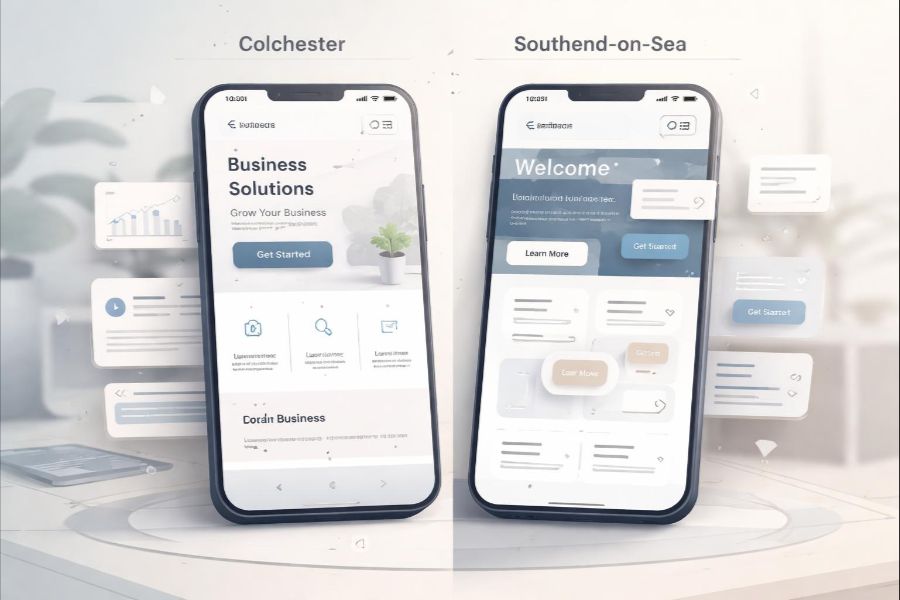
This affects engagement.
Takeaway:
Colchester websites show stronger mobile optimisation.
6. Content Depth & Service Explanation
Content depth plays a key role in user confidence.
Colchester websites tend to provide more detailed service explanations. Users can understand what is offered, how it works and what to expect.
Southend-on-Sea websites often provide more basic descriptions. Services are listed, but not always explained in depth.
This creates uncertainty.
Takeaway:
Colchester websites provide stronger content depth and clarity.
7. Content Clarity & Messaging
Clarity is essential for usability.
Colchester websites tend to communicate more directly. Messaging is clearer and users can quickly understand what the business offers.
Southend-on-Sea websites sometimes prioritise volume over clarity. Content is present, but not always structured effectively.
This increases cognitive load.
Takeaway:
Colchester communicates more effectively through clearer messaging.
8. Trust Signals & Credibility
Trust signals influence user confidence.
Colchester websites tend to present trust elements more clearly. Testimonials, reviews and contact details are easier to find.
Southend-on-Sea websites often include these elements, but they are not always prominent.
This reduces their impact.
Takeaway:
Colchester demonstrates stronger trust signalling.
9. Call-to-Action Strategy & User Direction
Calls to action are one of the clearest indicators of whether a website is built to convert or simply to present information.
Colchester websites tend to show a more structured and intentional approach to calls to action. Buttons such as “Get a Quote”, “Book a Consultation”, or “Contact Us” are typically placed at key decision points within the page. These placements align with user behaviour – appearing after key information has been delivered, when the user is most likely to act.
There is also consistency.
Calls to action are repeated across pages, reinforcing the same action regardless of where the user enters the site. This creates a smoother and more guided experience.
Southend-on-Sea websites often include calls to action, but they are less consistently implemented. Common issues include:
- Placement too far down the page
- Lack of visibility
- Generic or unclear wording
This creates hesitation.
Users may understand the service, but they are not clearly directed toward the next step.
Takeaway:
Colchester websites guide users more effectively through clearer and better-positioned calls to action.
10. Visual Design vs Functional Performance
Southend-on-Sea websites often show a stronger emphasis on visual presentation. This is likely influenced by the town’s tourism and hospitality sectors, where appearance plays a larger role.
Many sites include:
- High-quality imagery
- More dynamic layouts
- Strong visual branding
However, this can come at a cost.
Heavier design elements often lead to:
- Slower load times
- Increased complexity
- Reduced clarity
Colchester websites tend to take a more restrained approach. Visual design is present, but it is typically secondary to structure and usability.
This creates a different balance.
Southend websites may appear more visually engaging at first glance.
Colchester websites tend to perform more consistently over time.
11. Internal Linking & Site Connectivity
Internal linking plays a crucial role in both SEO and user navigation.
Colchester websites tend to demonstrate stronger internal linking structures. Pages are connected logically, allowing users to move between related services, supporting content and contact pages with ease.
This creates a cohesive experience.
It also helps search engines understand the relationship between pages.
Southend-on-Sea websites often show weaker internal linking. Pages can feel isolated, with limited pathways between them. Users may reach the end of a page without a clear direction on where to go next.
This reduces engagement and limits SEO effectiveness.
Takeaway:
Colchester websites benefit from stronger internal connectivity.
12. Homepage Effectiveness
The homepage is the most important structural page on a website.
Colchester homepages tend to be more structured and purposeful. Information is presented in a clear sequence:
- Introduction
- Services
- Supporting information
- Call to action
This helps users quickly understand what the business offers and what to do next.
Southend-on-Sea homepages often focus more on visual presentation. While this can create a strong first impression, it can also reduce clarity.
Users may need to scroll or interpret the layout to find key information.
Takeaway:
Colchester homepages provide stronger clarity and usability.
13. Consistency Across Pages
Consistency is a key indicator of build quality.
Colchester websites tend to maintain consistent layouts across pages. Headings, spacing and content structure follow predictable patterns. This makes the site easier to navigate and reinforces a professional feel.
Southend-on-Sea websites often show more variation. Different pages may use different layouts or structures, which can feel slightly disjointed.
Users may not consciously notice this, but it affects their perception.
Takeaway:
Colchester websites demonstrate stronger consistency across pages.
14. Scalability & Long-Term Flexibility
A website should be able to grow with the business.
Colchester websites, with clearer structural foundations, tend to be easier to expand. New pages and content can be added without disrupting the overall layout.
Southend-on-Sea websites, particularly those built with heavier design focus, can be harder to scale. Adding new content may require restructuring existing pages.
This creates long-term limitations.
Takeaway:
Colchester websites are generally more scalable and adaptable.
15. Performance Consistency Across Industries
Another key difference is consistency across different industries.
Colchester websites tend to show a more consistent level of quality across sectors such as professional services, trades and local businesses.
Southend-on-Sea websites show a wider range of quality. Some are strong, particularly in hospitality, but others fall behind in structure and performance.
This creates a larger gap between high-performing and low-performing sites.
Takeaway:
Colchester demonstrates a higher baseline level of website quality.
16. Cognitive Load & User Effort
Cognitive load refers to how much effort is required for a user to navigate and understand a website.
Colchester websites tend to reduce cognitive load. Clear layouts, consistent structure and direct messaging make it easier for users to process information.
Southend-on-Sea websites, particularly those with heavier design elements, can increase cognitive load. Users may need to interpret layouts or process more visual information.
Users prefer simplicity.
When a site feels easy to use, they stay longer and engage more.
Takeaway:
Colchester websites minimise user effort, improving engagement.
17. Alignment with Real User Behaviour
Most users:
- Scan content
- Make quick decisions
- Leave if something feels slow or unclear
Colchester websites tend to align more closely with these behaviours. They are easier to scan, faster to load and simpler to navigate.
Southend-on-Sea websites sometimes assume deeper engagement, presenting more visual elements and layered content.
This can reduce effectiveness.
Takeaway:
Colchester websites better reflect real user behaviour patterns.
18. Conversion Efficiency & Business Impact
All of these factors ultimately affect business outcomes.
Colchester websites, with stronger structure and clarity, are more likely to convert visitors into enquiries.
Southend-on-Sea websites may attract attention visually, but inconsistencies in usability can reduce conversion rates.
Small differences in:
- Speed
- Clarity
- Structure
Lead to significant differences in:
- Leads
- Enquiries
- Revenue
Takeaway:
Colchester websites are generally more effective at converting users into customers.
19. Competitive Positioning Within Essex
Colchester’s position as a historic and growing business hub has led to more consistent digital adoption. Businesses are more likely to invest in structured, performance-focused websites.
Southend-on-Sea, with its diverse and tourism-driven economy, shows more variation in approach. Some businesses prioritise visual appeal, while others focus less on digital presence.
Over time, structured approaches tend to outperform.
This broader trend is also reflected in the Romford vs Grays business website comparison, where differences in execution lead to clear performance gaps.
Takeaway:
Colchester is better aligned with long-term digital performance trends.
20. Build Philosophy & Strategic Approach
At the core of these differences is a shift in mindset.
Colchester websites tend to reflect a more strategic approach:
- Structure first
- Clarity first
- Performance first
Southend-on-Sea websites often reflect a more presentation-focused approach:
- Visual appeal
- Branding
- Immediate impression
Neither approach is inherently wrong.
But one is more aligned with measurable results.
Takeaway:
Colchester reflects a more performance-driven approach to website development.
21. The Hidden Cost of Inconsistent Website Quality
One of the most important insights from comparing Colchester and Southend-on-Sea is not simply which town has “better” websites – it is how consistency of quality impacts performance.
Most Southend websites are not fundamentally broken. They:
- Load
- Present services
- Allow users to make contact
From a basic perspective, they work.
But this creates a false sense of effectiveness.
The hidden cost lies in small inefficiencies:
- Slightly slower load times
- Slightly unclear navigation
- Slightly inconsistent layouts
Individually, these issues seem minor.
But together, they create friction.
Users hesitate.
They spend less time on the site.
They are less likely to convert.
Colchester websites, by being more consistent in structure and clarity, reduce this friction. They may not always look dramatically better, but they perform more reliably.
Takeaway:
Performance gaps are driven by accumulated inefficiencies, not obvious failures.
22. Why Southend Websites Often Plateau
A clear pattern across Southend-on-Sea websites is stagnation.
Many sites appear to have been built once and then left unchanged. Over time:
- Content becomes outdated
- Structure becomes limiting
- Performance falls behind
This creates a plateau.
The website continues to exist, but it stops improving.
Colchester websites, by contrast, often show signs of iteration. Content is updated, pages are expanded and structure evolves.
This reflects a different mindset:
Southend – build and leave
Colchester – build and improve
Over time, this difference becomes significant.
Takeaway:
Continuous improvement is a key driver of long-term website performance.
23. The Influence of Industry Mix
The types of businesses in each town influence how websites are built.
Southend-on-Sea has a strong presence of:
- Hospitality
- Tourism
- Leisure businesses
These industries often prioritise visual appeal and branding.
This can lead to:
- More design-heavy websites
- Greater emphasis on imagery
- Less focus on structure and SEO
Colchester, with a stronger presence of:
- Professional services
- Education-linked businesses
- B2B services
Tends to favour:
- Clear structure
- Informational content
- Performance-focused builds
This difference in industry mix influences overall website quality.
Takeaway:
Business type influences website priorities – and ultimately performance.
24. Speed as a Competitive Differentiator
Speed is one of the few factors that affects every aspect of website performance.
It influences:
- First impressions
- User engagement
- Conversion rates
- SEO rankings
Colchester websites tend to maintain more consistent speed, reinforcing usability and trust.
Southend-on-Sea websites, particularly those with heavier visual elements, can show more variability.
Even small delays can have a significant impact.
Users do not wait.
They leave.
Takeaway:
Speed is a critical competitive advantage, not just a technical metric.
25. The Compounding Effect of Small Improvements
One of the most important patterns across this comparison is how small improvements compound.
Consider:
- Slightly clearer navigation
- Slightly faster loading
- Slightly better messaging
Each change seems minor.
But together, they create a significantly better experience.
Colchester websites benefit from this compounding effect. They are consistently improved across multiple areas.
Southend websites often show isolated strengths, particularly in design, but less consistency overall.
Takeaway:
Consistency across small improvements creates a major performance advantage.
26. SEO Implications & Visibility for Essex Businesses
From an SEO perspective, these differences become critical.
Search engines prioritise:
- Structured content
- Fast load times
- Internal linking
- Clear user experience
Colchester websites tend to align more closely with these factors.
Southend-on-Sea websites, with more variability, may struggle to achieve consistent rankings.
This is particularly relevant for competitive keywords such as:
- “web design Colchester”
- “local services Colchester”
- “business services Essex”
Consistency strengthens SEO signals.
Takeaway:
Colchester websites are better aligned with modern SEO requirements.
27. User Trust and Decision-Making
Trust is built through multiple small signals.
Users respond to:
- Speed
- Clarity
- Ease of use
Colchester websites reinforce trust through consistency.
Southend websites may create a strong first impression visually, but inconsistencies in performance can weaken that trust.
Users may not consciously identify the issue.
But they feel it.
And that feeling influences decisions.
Takeaway:
Trust is built through consistent performance, not just design.
28. What This Means for Local Businesses
For business owners in both towns, the implications are clear.
A website is not judged solely on appearance.
It is judged on:
- How fast it loads
- How easy it is to use
- How clearly it communicates
Many businesses assume they need:
- A redesign
- A more modern look
In reality, they often need:
- Better structure
- Clearer messaging
- Improved performance
These improvements are less visible, but far more impactful.
Takeaway:
Improving fundamentals delivers stronger results than focusing on visuals alone.
29. Strategic Lessons for Essex Businesses
- Structure should come before design
- Speed should not be sacrificed for aesthetics
- Clarity is more important than creativity
- Simplicity improves usability
- Consistency drives performance
30. The Future of Local Business Websites (2026 and Beyond)
As competition continues to increase, the gap between high-performing and underperforming websites will widen.
Users will expect:
- Faster load times
- Clearer navigation
- Simpler user journeys
Search engines will continue to prioritise:
- Performance
- Structure
- User experience
Colchester websites are already closer to this model.
Southend-on-Sea websites that do not adapt may fall behind.
Takeaway:
The future belongs to performance-driven websites, not design-driven ones.
Final Strategic Summary
| Area | Colchester Insight | Southend-on-Sea Insight |
|---|---|---|
| Build Approach | Structured, performance-focused | Visual, varied |
| Speed | Consistent | Variable |
| SEO | Stronger foundation | Less consistent |
| UX | Clear and guided | Mixed |
| Conversion | More reliable | Less predictable |
| Scalability | Strong | Limited |
Key Findings (For Media & Sharing)
- Colchester websites show more consistent structure than Southend
- Website consistency directly improves conversion performance
- Speed and usability outperform visual design in effectiveness
- Variation in build quality reduces overall website performance
- Strong structure leads to more reliable search visibility
Commercial Insight Layer
For businesses investing in web design in Essex, the takeaway is straightforward:
A better-looking website is not necessarily a better-performing website.
The priority should be:
- Structure
- Speed
- Clarity
Businesses that focus on these areas will achieve stronger long-term results.
Final Conclusion
Colchester and Southend-on-Sea both represent strong business environments.
But when it comes to website quality, a clear pattern emerges.
Colchester shows greater consistency.
Southend shows greater variation.
And consistency is what drives performance.
Because ultimately, users care about:
- Ease
- Speed
- Clarity
Not just appearance.
The conclusion is simple.
The best business websites are not the ones that look the most impressive.
They are the ones that work the most effectively.