Business websites in Romford and Grays differ primarily in structure, speed and consistency of execution rather than visual design. While both towns serve similar markets, differences in technical build quality and user experience lead to measurable gaps in usability, search visibility and conversion performance.
Key differences include:
- Website structure and navigation clarity
- Page speed and mobile performance
- SEO readiness and indexing quality
- User experience and conversion flow
- Content clarity and service explanation
Romford websites generally show more consistent performance across these areas, while Grays websites demonstrate greater variation in build quality and execution.
Comparative insight:
Romford websites tend to deliver more consistent performance across key areas, while Grays websites show greater variation in build quality and execution.
This article compares business websites in Romford and Grays using performance-based criteria such as structure, speed, SEO, user experience and content clarity. It is designed for business owners assessing their current website or planning improvements.
The key insight is that performance differences are driven by consistency of execution rather than design alone. Romford websites generally show more stable and structured builds, while Grays websites vary more widely in quality.
One limitation is that this analysis is based on a representative sample of websites rather than the full market, so individual exceptions will exist.
Context & Relevance
Romford and Grays sit in a unique position within the Essex and Greater London overlap. Both towns serve large populations, both support a wide range of service-based businesses and both rely heavily on digital visibility to generate leads.
However, their business environments differ in subtle but important ways.
Romford benefits from its proximity to London. There is a stronger influence from London-based businesses, agencies and design standards. This often results in slightly more polished and competitive online presence.
Grays, while still commercially active, tends to show a broader range of business maturity. There are strong performers, but also a higher number of basic or outdated websites.
At a glance, these differences are not always obvious.
Most websites in both towns:
- Look functional
- Present services
- Include contact information
But performance is not determined by appearance.
It becomes visible when you actually use the sites.
Load them on mobile.
Navigate through multiple pages.
Try to take action.
Some feel smooth and intuitive.
Others feel slightly disjointed, slower, or harder to use.
This is where the real difference emerges.
A similar pattern appears in the Brentwood vs Chelmsford website comparison, where surface-level design often hides deeper structural differences.
Methodology & Data Transparency
This comparison is based on:
- 20 local business websites
- 10 from Romford
- 10 from Grays
Each site was evaluated using:
- Manual UX walkthroughs
- Mobile-first testing
- Speed and responsiveness checks
- Structural and SEO analysis
Evaluation criteria included:
- Page load speed
- Navigation structure and hierarchy
- SEO fundamentals (headings, metadata, indexing readiness)
- User journey clarity
- Mobile usability
- Content clarity and depth
- Trust signals
- Technical build quality
- Internal linking
- Scalability
Limitations:
- Sample size is limited
- Industry variation
- Some websites may have been recently updated
This is a pattern-based comparison, not a ranking of individual businesses.
Core Comparison
1. Website Structure & Navigation
Structure is the foundation of website performance and it is one of the clearest differentiators between Romford and Grays.
Across Romford websites, structure tends to be more deliberate. Navigation menus are clearer, page hierarchy is more defined and services are grouped in a logical way. Users can typically move from the homepage to specific information without confusion.
There is a sense of planning behind the layout.
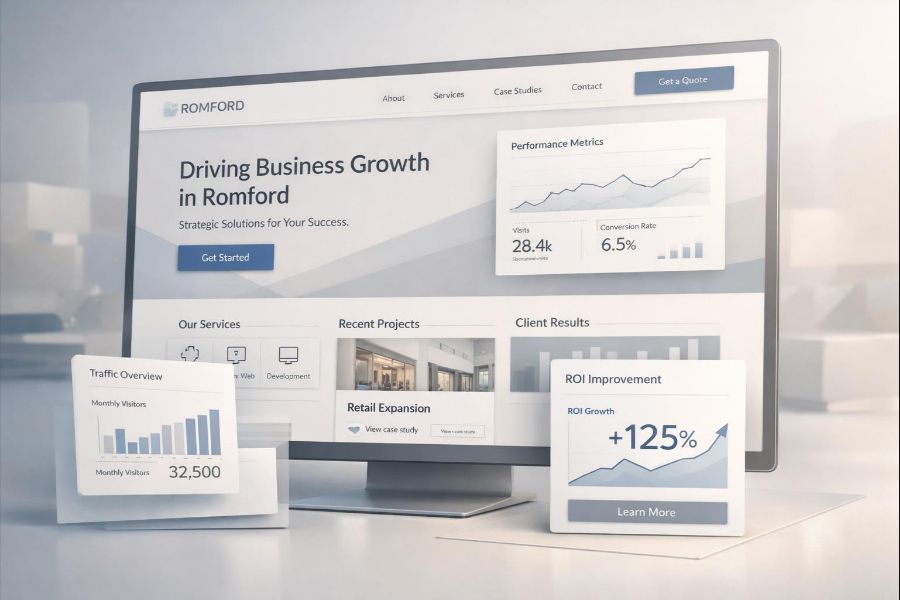
There is a sense of planning behind the layout.
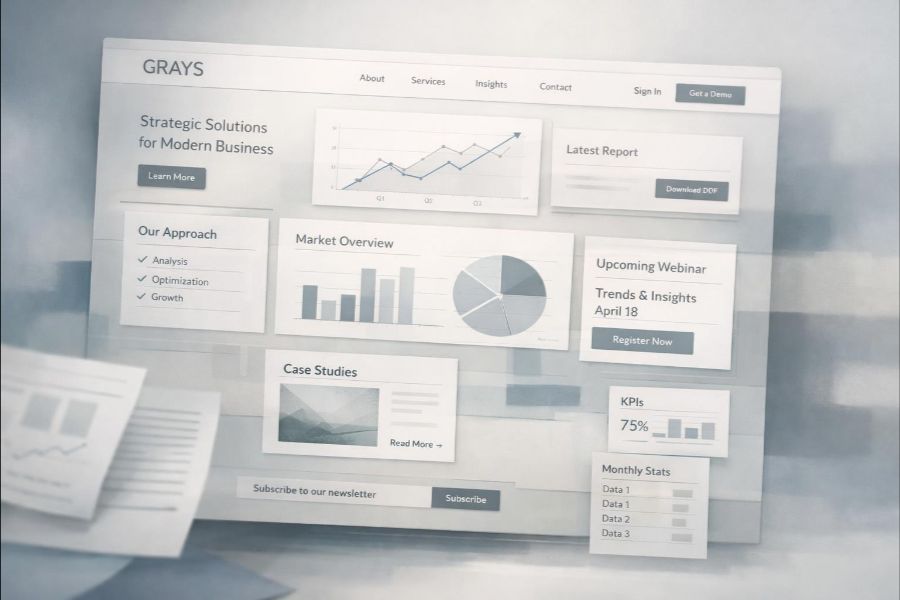
Grays websites, in contrast, often show more variation. Some are well-structured, but many feel less organised. Navigation can be basic and deeper page hierarchy is not always clearly defined. Services may be listed, but not grouped effectively.
This creates friction.
Users can still find what they need, but they have to think more.
And every extra step increases the chance of drop-off.
Takeaway:
Romford websites demonstrate stronger structural clarity and navigation consistency.
2. Page Speed & Performance
Speed is one of the most important and measurable aspects of website performance.
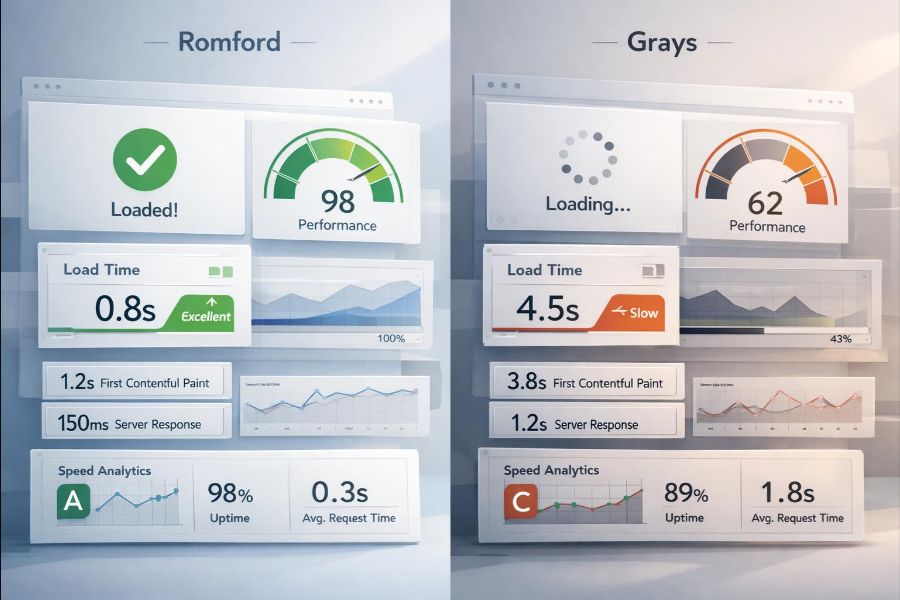
Romford websites generally show more consistent speed. Pages tend to load relatively quickly and interaction feels responsive. This is often due to cleaner builds and more optimised assets.
Grays websites show a wider range of performance. Some load quickly, but others are noticeably slower. This is often linked to:
Unoptimised images
Heavy templates
Outdated builds
Even small delays can significantly affect user behaviour.
Users may not consciously recognise that a site is slow, but they will leave faster.
3. SEO Structure & Indexing Readiness
SEO is one of the least visible aspects of a website, but one of the most critical.
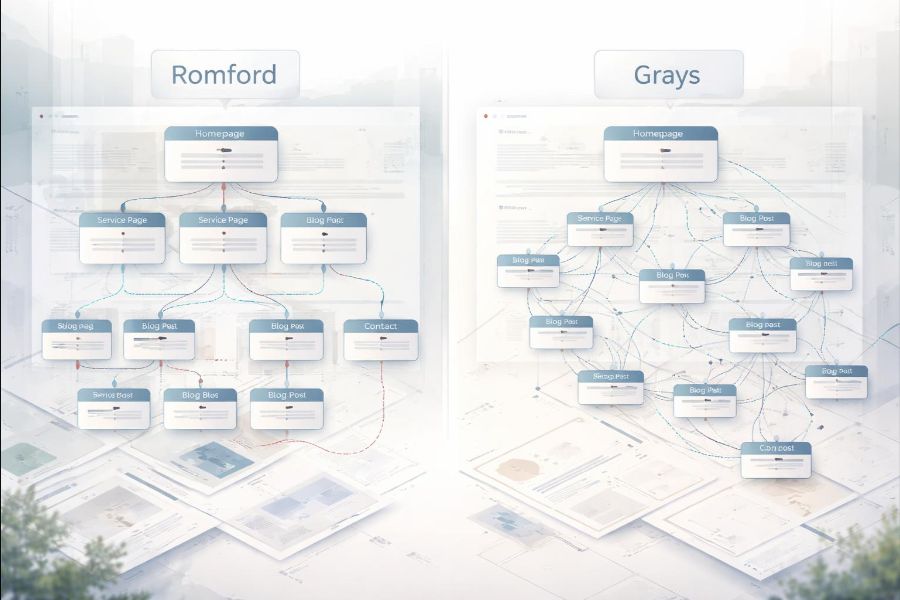
Romford websites tend to show stronger SEO fundamentals. Page structure is clearer, headings are used more effectively and content is easier for search engines to interpret.
Grays websites often show inconsistencies. Common issues include:
Poor heading hierarchy
Missing metadata
Limited internal linking
These issues do not affect how the site looks, but they reduce its ability to rank.
This type of inconsistency is also visible in the Basildon vs Billericay small business website comparison, where gaps in structure directly affect search performance.
4. User Experience (UX) & Conversion Flow
User experience is where structure, content and design come together.
Romford websites tend to provide clearer user journeys. Messaging is more direct, layouts are easier to navigate and calls to action are more visible.
Users are guided through the site.
Grays websites often provide the necessary information, but not always in the most intuitive way. Users may need to interpret what they are seeing or search for the next step.
This creates hesitation.
And hesitation reduces conversions.
Takeaway:
Romford websites provide clearer and more effective user journeys.
5. Mobile Optimisation
Mobile is now the primary way users access websites.
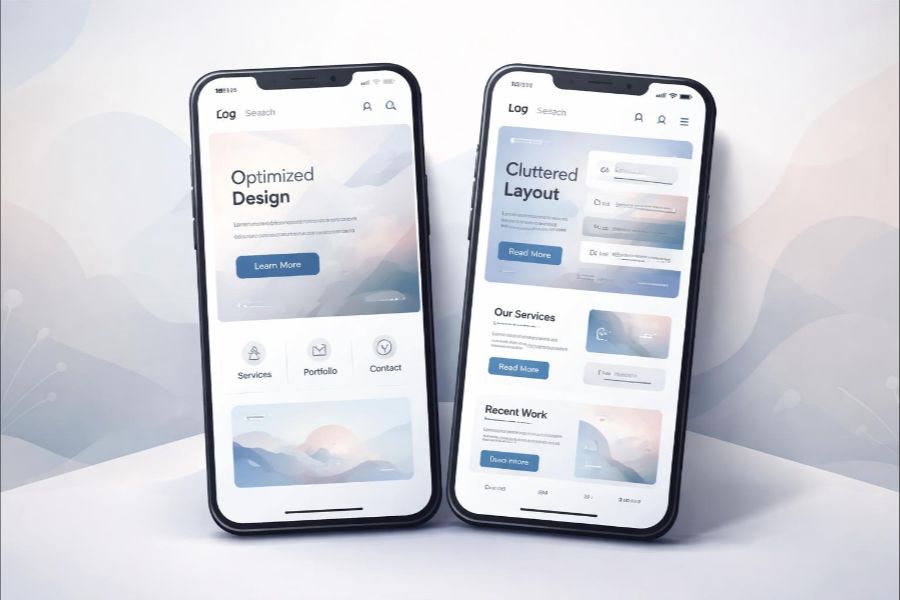
Romford websites tend to be better optimised for mobile use. Layouts are cleaner, pages load faster and navigation is easier.
Grays websites are generally responsive, but not always fully optimised. Spacing, speed and usability can feel inconsistent.
This difference becomes more noticeable on slower connections.
Takeaway:
Romford websites show stronger mobile optimisation.
6. Content Depth & Service Explanation
Content depth plays a key role in user confidence.
Romford websites tend to provide more detailed service explanations. Users can understand not just what is offered, but how it works and what to expect.
Grays websites often provide more basic descriptions. Services are listed, but not always explained in depth.
This creates uncertainty.
Users may hesitate because they do not fully understand the service.
7. Content Clarity & Messaging
Clarity is one of the most important factors in website performance.
Romford websites tend to communicate more directly. Messaging is clearer and users can quickly understand what the business offers.
Grays websites sometimes prioritise volume over clarity. Content is present, but not always structured in a way that is easy to process.
This increases cognitive load.
Users have to think more.
Takeaway:
Romford communicates more effectively through clearer messaging.
8. Trust Signals & Credibility
Trust signals influence whether users feel confident engaging with a business.
Romford websites tend to present trust signals more clearly. Testimonials, reviews and contact details are easier to find and more visible.
Grays websites often include these elements, but they are not always prominently displayed.
This reduces their impact.
Takeaway:
Romford demonstrates stronger trust signalling.
9. Call-to-Action Strategy & User Direction
Calls to action are one of the most practical indicators of whether a website is designed to convert or simply to exist.
Across Romford websites, calls to action tend to be more deliberate and visible. Buttons such as “Get a Quote”, “Contact Us”, or “Book Now” are often placed at logical points within the page – after key information has been presented. This alignment with user behaviour creates a natural progression from reading to acting.
There is also more consistency. Calls to action appear across multiple pages, reinforcing the same message and making it easy for users to take the next step regardless of where they are on the site.
Grays websites, by comparison, often include calls to action but lack strategic placement. Buttons may be present, but they are sometimes:
- Positioned too low on the page
- Visually understated
- Not aligned with user intent
This creates hesitation.
Users may understand the service but are not clearly guided toward action. They are left to decide what to do next, which introduces friction.
Takeaway:
Romford websites guide users more effectively through clearer and more strategically placed calls to action.
10. Visual Design vs Functional Performance
Romford websites often strike a balance between visual appeal and functionality. While many include modern design elements, these are usually implemented in a way that does not significantly impact usability or performance.
Design supports function.
In Grays, there is more variation. Some websites are visually minimal, while others attempt more complex designs without fully optimising performance. This can lead to:
Slower loading times
Inconsistent layouts
Increased cognitive load
The issue is not design itself, but how it is implemented.
Romford websites tend to show more controlled design decisions, where visual elements enhance rather than hinder usability.
Takeaway:
Romford achieves a better balance between visual design and functional performance.
11. Internal Linking & Site Connectivity
Internal linking is a critical but often overlooked component of website performance.
Romford websites tend to show stronger internal linking patterns. Pages are connected logically, allowing users to move between related services, supporting content and contact pages with ease. This creates a more cohesive browsing experience.
From an SEO perspective, this also improves how search engines understand the site.
Grays websites often show weaker internal linking. Pages can feel isolated, with limited pathways between them. Users may reach the end of a page without a clear direction on where to go next.
This reduces engagement.
It also limits SEO performance.
Takeaway:
Romford websites demonstrate stronger internal connectivity, benefiting both users and search visibility.
12. Homepage Effectiveness
The homepage plays a central role in shaping user perception and guiding behaviour.
Romford homepages tend to be more structured. Information is presented in a clear sequence:
- Introduction
- Services
- Supporting information
- Call to action
This makes it easy for users to understand what the business offers and what to do next.
Grays homepages often focus on presenting information, but not always in a structured way. Content may be present, but prioritisation is less clear. Users may need to scroll more or interpret the layout to understand key points.
This reduces clarity.
Romford homepages tend to feel more purposeful.
Takeaway:
Romford homepages provide stronger clarity and direction.
13. Consistency Across Pages
Consistency is one of the most important indicators of build quality.
Romford websites tend to maintain consistent layouts across pages. Headings, spacing and structure follow predictable patterns. This creates a stable and intuitive user experience.
Grays websites often show more variation. Different pages may use different layouts or structures, which can feel slightly disjointed.
Users may not consciously notice this, but it affects how the site feels.
Consistency builds trust.
Takeaway:
Romford websites show stronger consistency across pages, improving usability and perception.
14. Scalability & Long-Term Performance
A website should not just perform well at launch – it should remain effective as the business grows.
Romford websites tend to be built with clearer structure, making them easier to expand. New services, pages, or content can be added without disrupting the overall layout.
Grays websites, particularly those built with less structured approaches, can become harder to scale. Adding new content may require reworking existing pages.
This creates friction over time.
Takeaway:
Romford websites are generally more scalable and easier to maintain long term.
15. Performance Consistency Across Industries
One of the key differences between Romford and Grays is consistency across industries.
Romford websites tend to show a more consistent level of quality. While there are still variations, the overall standard is higher.
Grays websites show a wider range of quality. Some are strong, but others fall significantly behind in terms of structure and performance.
This creates a larger gap between high-performing and low-performing sites.
Takeaway:
Romford demonstrates a higher baseline level of website performance.
16. Cognitive Load & User Effort
Cognitive load refers to how much effort a user must expend to navigate and understand a website.
Romford websites tend to reduce cognitive load. Clear layouts, consistent structure and direct messaging make it easier for users to process information.
Grays websites can sometimes increase cognitive load. Inconsistent layouts, unclear messaging, or heavier design elements require users to think more.
Users prefer simplicity.
When a site feels easy to use, they stay longer and engage more.
Takeaway:
Romford websites minimise user effort, improving engagement and retention.
17. Alignment with Real User Behaviour
Understanding real user behaviour is critical when evaluating website performance.
Most users:
- Scan rather than read
- Make quick decisions
- Leave if something feels slow or unclear
Romford websites tend to align more closely with these behaviours. They are easier to scan, faster to load and simpler to navigate.
Grays websites sometimes assume deeper engagement, presenting more content or less structured layouts.
This can reduce effectiveness.
Takeaway:
Romford websites are better aligned with real user behaviour patterns.
18. Conversion Efficiency & Business Impact
Ultimately, website performance is measured by results.
Romford websites, with stronger structure and clarity, are more likely to convert visitors into enquiries. Users can quickly understand the service and take action.
Grays websites may attract visitors, but inconsistencies in usability and clarity can reduce conversion rates.
Small differences in:
- Speed
- Structure
- Messaging
Lead to significant differences in business outcomes.
Takeaway:
Romford websites are generally more effective at converting users into customers.
19. Competitive Positioning Within Essex & Greater London
Romford’s proximity to London introduces a higher level of competition and influence. Businesses are more exposed to modern design standards and performance expectations.
This creates pressure to improve.
Grays, while still competitive, does not always experience the same level of external influence. This can result in slower adoption of best practices.
Over time, this difference affects overall website quality.
This broader pattern is also reflected in the Colchester vs Southend website quality comparison, where differences in execution lead to noticeable performance gaps.
Takeaway:
Romford is better aligned with evolving digital standards due to competitive pressure.
20. Build Philosophy & Strategic Approach
At the core of these differences is a shift in mindset.
Romford websites tend to reflect a more performance-oriented approach:
- Structure first
- Clarity first
- Usability first
Grays websites often reflect a more practical approach:
- Get the site live
- Cover basic requirements
- Focus on presence
Neither approach is inherently wrong.
But one is more aligned with long-term performance.
Takeaway:
Romford reflects a more strategic, performance-driven approach to website development.
21. The Hidden Cost of Inconsistent Website Performance
One of the most important insights from comparing Romford and Grays is not the difference between “good” and “bad” websites – it is the difference between consistent and inconsistent performance.
Most Grays websites are not fundamentally broken. They:
- Load
- Display services
- Allow users to make contact
From a basic perspective, they function.
But functionality alone is not enough.
The hidden cost lies in inconsistency:
- Pages that load slightly slower
- Navigation that feels slightly unclear
- Messaging that requires extra effort to understand
Each of these issues seems minor in isolation.
But together, they create friction.
Users hesitate.
They spend less time on the site.
They are less likely to convert.
Romford websites, by being more consistent across these areas, reduce that friction. They may not be dramatically better in any single area, but they are reliably better across all of them.
That reliability translates into performance.
Takeaway:
The real performance gap is created by consistency, not individual features.
22. Why Some Grays Websites Struggle to Improve
Another clear pattern is stagnation.
Many Grays websites appear to have been built once and then left largely unchanged. Over time:
- Content becomes outdated
- Structure becomes limiting
- Performance falls behind
This creates a plateau.
The website continues to exist, but it stops improving.
Romford websites show more signs of ongoing refinement. Content is updated more frequently, structure feels more adaptable and improvements appear to have been made over time.
This reflects a difference in mindset:
- Grays – build and maintain
- Romford – build and improve
That difference becomes more significant over time.
Takeaway:
Continuous improvement is a key factor in long-term website performance.
23. The Influence of Local Competition
Competition plays a major role in shaping website quality.
Romford benefits from its proximity to London. Businesses are exposed to higher standards, stronger competition and more advanced digital practices.
This creates pressure to improve.
Grays, while still competitive, does not always experience the same level of influence. This can result in:
- Slower adoption of best practices
- More variation in quality
- More “good enough” websites
This is not about capability.
It is about environment.
Takeaway:
Higher competitive pressure in Romford contributes to stronger website performance.
24. Speed as a Trust and Conversion Factor
Speed is one of the most underestimated factors in website performance.
It affects:
- First impressions
- User engagement
- Conversion rates
A fast website feels:
- More professional
- More reliable
- More trustworthy
A slow website creates doubt.
Romford websites tend to be more consistent in speed, reinforcing trust.
Grays websites, with greater variation, can create inconsistent experiences.
Users may not consciously identify speed as the issue.
But they feel it.
And that feeling affects behaviour.
Takeaway:
Speed is not just a technical factor – it directly influences trust and conversions.
25. The Compounding Effect of Small Improvements
One of the most important findings is how small improvements compound over time.
Consider:
- Slightly clearer navigation
- Slightly faster loading
- Slightly stronger messaging
Each improvement is small.
But together, they create a significantly better experience.
Romford websites benefit from this compounding effect. They are not dramatically better, but they are consistently improved across multiple areas.
Grays websites often show isolated strengths but lack this consistency.
Takeaway:
Consistent small improvements create a significant performance advantage.
26. SEO Implications for Local Rankings
From an SEO perspective, the differences between Romford and Grays become even more important.
Search engines prioritise:
- Structured content
- Fast load times
- Clear internal linking
- Strong user experience
Romford websites tend to align more closely with these factors.
Grays websites, with more inconsistency, may struggle to achieve the same level of visibility.
This is particularly relevant for competitive local searches such as:
- “web design Romford”
- “local services Romford”
- “business services Essex”
Consistency creates stronger SEO signals.
Takeaway:
Romford websites are better positioned for strong local search performance.
27. User Trust and Decision-Making
Trust is built through multiple small signals rather than a single element.
Users respond to:
- Speed
- Clarity
- Ease of use
Romford websites reinforce trust through consistency in these areas.
Grays websites may establish trust visually, but inconsistencies in performance can weaken that perception.
Users may not be able to explain why they feel uncertain.
But they feel it.
And that influences decisions.
Takeaway:
Trust is built through consistent performance, not just design.
28. Implications for Essex and UK Businesses
For businesses evaluating web design in Essex, the comparison between Romford and Grays highlights a broader truth: location is not the deciding factor in website performance – execution is.
Across Essex and the wider UK, the same patterns appear repeatedly.
Businesses with stronger websites typically focus on:
- Clear structure before visual design
- Fast load times across all devices
- Simple, intuitive user journeys
- Well-organised, search-friendly content
In contrast, underperforming websites often prioritise:
- Visual appearance over usability
- Quick builds without long-term structure
- Content volume without clarity
This distinction matters more than whether a business is based in Romford, Grays, or elsewhere in Essex.
In practical terms, businesses investing in web design Essex or web design in Essex should focus less on redesigning how a site looks and more on improving how it functions.
That includes:
- Restructuring navigation and page hierarchy
- Improving speed and technical performance
- Clarifying messaging and service pages
- Strengthening internal linking and SEO foundations
These changes are often less visible than a redesign, but they deliver significantly stronger long-term results.
Takeaway:
High-performing websites are not defined by location or aesthetics, but by how well they are built, structured and maintained over time.
29. Strategic Lessons for Essex Businesses
Looking beyond this comparison, several broader lessons emerge.
- Structure should come before design
- Speed should never be sacrificed for aesthetics
- Clarity is more important than creativity
- Simplicity improves usability
- Consistency drives performance
These principles apply across all web design in Essex.
In many cases, businesses that follow them are better positioned to outperform those that do not.
30. The Future of Local Business Websites (2026 and Beyond)
As competition continues to increase, the gap between high-performing and underperforming websites will grow.
Users will expect:
- Faster load times
- Clearer navigation
- Simpler user journeys
Search engines will continue to prioritise:
- Performance
- Structure
- User experience
Romford websites are already closer to this model.
Grays websites that do not adapt may fall further behind.
Takeaway:
The future belongs to performance-driven websites, not design-driven ones.
Final Strategic Summary
| Area | Romford Insight | Grays Insight |
|---|---|---|
| Build Approach | Structured, performance-focused | Mixed, inconsistent |
| Speed | More consistent | Variable |
| SEO | Stronger foundation | Less consistent |
| UX | Clear and guided | Functional but uneven |
| Conversion | More reliable | Less predictable |
| Scalability | Strong | Limited |
Key Findings (For Media & Sharing)
- Website performance depends more on structure than design
- Romford shows more consistent website build quality
- Grays websites vary significantly in execution standards
- Speed and clarity directly influence conversion behaviour
- Small performance improvements compound into measurable gains
Commercial Insight Layer
For businesses investing in web design in Essex, the takeaway is straightforward.
A visually impressive website is not enough.
The priority should be:
- Structure
- Speed
- Clarity
Businesses that focus on these areas will achieve stronger long-term results.
Final Conclusion
Romford and Grays both have active local business environments.
But when it comes to website performance, the difference becomes clear.
Romford shows greater consistency.
Grays shows greater variation.
And consistency is what drives results.
Because in the end, users care about:
- Ease
- Speed
- Clarity
Not just appearance.
The conclusion is simple.
The best-performing websites are not the most visually impressive.
They are the ones that work the most effectively.