
Business websites in Brentwood and Chelmsford show consistent differences in how they are structured, built and how they perform. While both towns have strong business environments, website effectiveness is primarily driven by technical build quality, not visual design alone. These differences directly affect usability, search visibility and conversion performance.
Key differences include:
- Navigation structure and logical hierarchy
- Page speed and mobile performance
- SEO readiness and internal linking
- User experience and conversion clarity
- Content depth and messaging
Concise comparison:
In most cases, Chelmsford websites demonstrate stronger technical consistency, while Brentwood websites often prioritise visual presentation.
This article compares business websites in Brentwood and Chelmsford using practical performance criteria including structure, speed, SEO, user experience and technical build quality. It is intended for business owners assessing their current website or considering improvements.
The key insight is simple: most websites underperform not because they look poor, but because they are built without strong structural foundations. Chelmsford websites tend to show more consistency in these areas. A key limitation is that findings are based on a representative sample rather than every business in each town.
At a glance, business websites in Brentwood and Chelmsford appear broadly similar.
You will see modern layouts, clean branding and clearly presented services in both towns. On the surface, there is little to separate them.
But that impression does not hold under closer use.
The difference becomes clear when you move beyond the homepage. When you navigate between pages. When you try to find specific information. When you use the site on mobile.
Some websites feel immediate and intuitive. Others introduce small moments of hesitation.
Those moments are where performance is lost.
And across repeated observations of Essex business websites, the same pattern appears.
The difference is not how much effort has gone into the design. It is how the website has been structured and built.
That is where Chelmsford consistently edges ahead.
Context & Relevance
Brentwood and Chelmsford are often positioned as comparable business environments within Essex. Both towns attract service-based businesses, both have strong local economies and both are increasingly competitive when it comes to digital visibility.
At first glance, their websites reflect this.
You will see modern layouts, clean branding and clearly listed services across both towns. From a surface perspective, there appears to be little difference.
But surface-level impressions are misleading.
The real difference only becomes clear when you interact with these websites properly. Not just scanning the homepage, but navigating deeper. Moving between pages. Trying to find specific information. Using them on mobile.
That is where performance reveals itself.
Some websites feel smooth, almost effortless. You instinctively know where to go next. Pages load quickly. Information is easy to process.
Others feel slightly disjointed. Slower. Less intuitive. You hesitate. You search. You wait.
That hesitation is where performance is lost.
And it is not random.
Across repeated observations of Essex business websites, the same pattern appears.
This comparison forms part of a wider review of website performance across the region. For a broader breakdown of what defines strong web design in Essex, see our complete guide.
The difference is not how much effort has gone into the design. It is how the website has been structured and built.
That is where Chelmsford consistently edges ahead.
Methodology & Data Transparency
This comparison is based on:
- 20 small and medium business websites
- 10 from Brentwood
- 10 from Chelmsford
Each website was evaluated using:
- Manual UX walkthroughs
- Mobile-first testing
- Speed and responsiveness checks
- Structural and SEO analysis
Evaluation criteria included:
- Load speed and performance
- Navigation structure and hierarchy
- SEO fundamentals (headings, metadata, indexing)
- User journey clarity
- Mobile usability
- Content depth and clarity
- Trust signals
- Technical build quality
- Internal linking
- Scalability
Limitations:
- Sample size is limited
- Industry variation affects complexity
- Some websites may have been recently updated
This is not a ranking of individual businesses. It is a pattern-based comparison.
Core Comparison
1. Website Structure & Navigation
Structure is where the first meaningful separation appears and it is also one of the most misunderstood aspects of website performance.
In Brentwood, many websites are built with a design-first approach. The homepage is often polished, visually appealing and well-branded. At a glance, everything looks professional. However, when you move beyond that initial layer, the structure often begins to loosen.
Pages may feel disconnected. Service groupings are not always logical. Navigation appears simple but lacks depth. Users can still find what they need, but it requires effort. They have to think and that introduces friction.

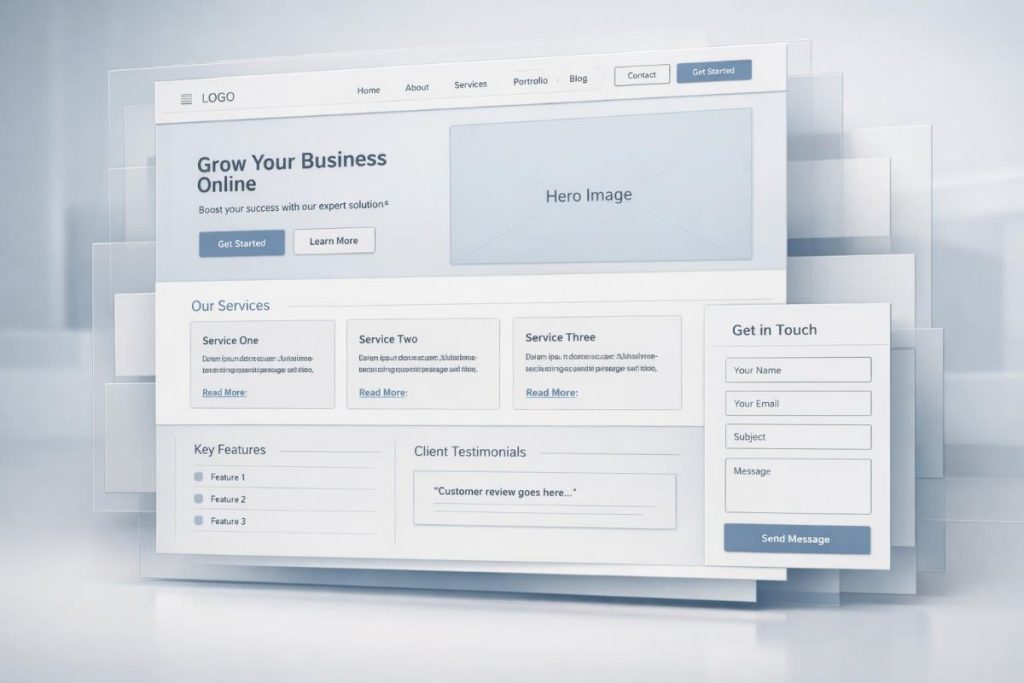
Chelmsford websites tend to follow a different pattern. Structure appears to be considered earlier in the build process. Pages are organised into clearer hierarchies, with a more logical flow from general to specific.
A typical structure might follow:
- Homepage overview
- Core service pages
- Supporting content
- Clear contact pathways
This makes navigation more intuitive. Users do not need to guess where information is located. They move through the site naturally.
Over time, this difference compounds. What feels like a small improvement in clarity becomes a significant improvement in usability.
Takeaway:
Chelmsford websites are easier to navigate because they are built with structure as a priority rather than an afterthought.
2. Page Speed & Performance
Speed is where design decisions become measurable.
Brentwood websites often lean heavily into visual presentation. Large hero sections, high-resolution imagery and animation effects are common. These elements create a strong first impression, but they come with a cost.
Even small delays in loading time can have a noticeable impact on user behaviour. Users may not consciously recognise that a site is slow, but they will feel it. They are more likely to leave, less likely to explore and less likely to convert.
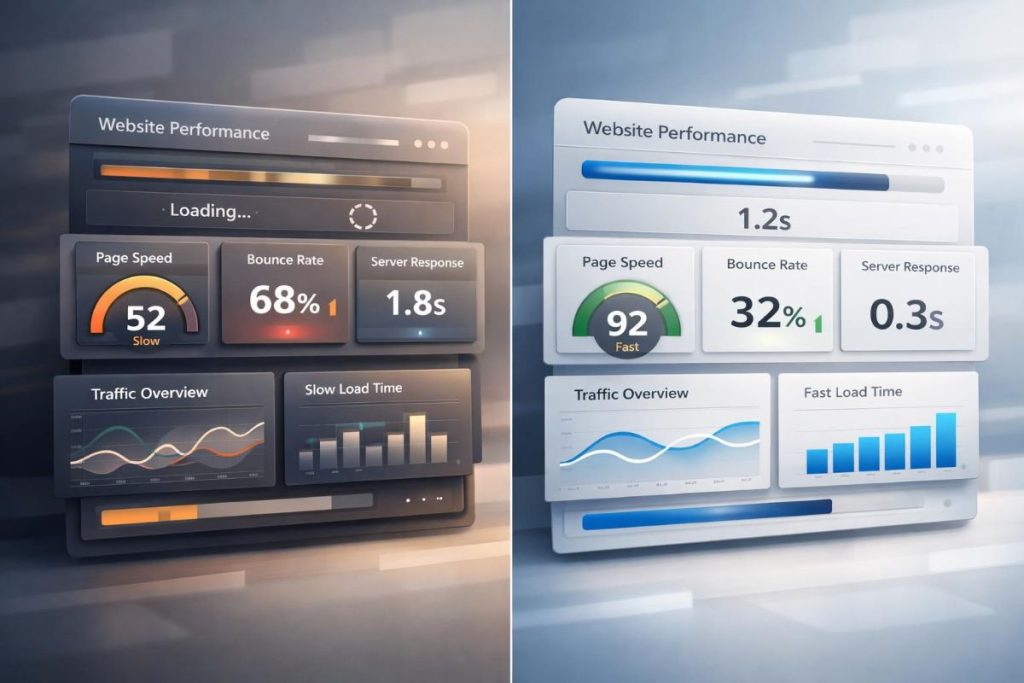
Chelmsford websites tend to be more restrained in their use of heavy design elements. Pages are often lighter, cleaner and more focused on performance. This results in faster loading times and smoother interaction, particularly on mobile devices.
The difference is not dramatic in isolation, but it is consistent across multiple interactions.
Takeaway:
Chelmsford websites generally perform better because they are built with performance in mind rather than visual impact alone.
3. SEO Structure & Indexing Readiness
SEO is one of the least visible aspects of a website, but one of the most important.
Across Brentwood websites, SEO implementation is often inconsistent. It is common to see weak heading structures, missing metadata and limited internal linking. These issues do not affect how the website looks, but they significantly impact how it performs in search engines.
This same issue appears in the Basildon vs Billericay small business website comparison, where structural SEO gaps also affect how easily business websites can be understood and ranked.
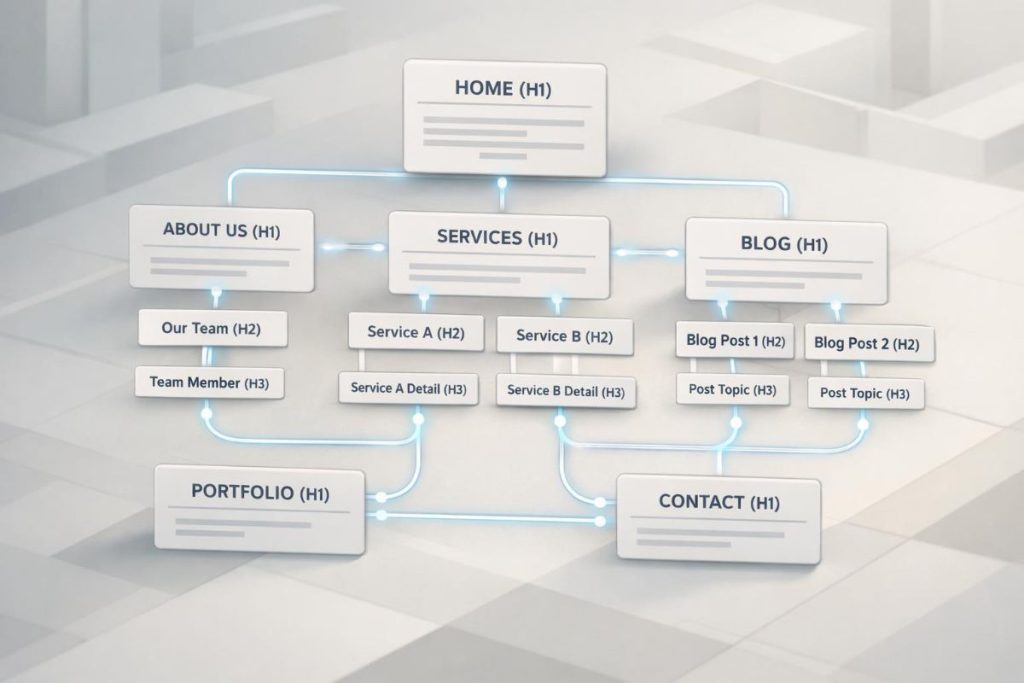
Chelmsford websites tend to show more consistency in SEO fundamentals. Page structures are clearer, headings are used more effectively and content is organised in a way that is easier for search engines to interpret.
Neither town demonstrates perfect SEO implementation, but Chelmsford shows a higher baseline level of competence.
Takeaway:
Chelmsford websites are generally better prepared for search visibility due to stronger structural SEO foundations.
4. User Experience (UX) & Conversion Flow
User experience is where all of these elements come together.
Similar user-flow differences also appear in the Harlow vs Epping online presence comparison, where consistency and clarity influence how easily users move through local business websites.
Brentwood websites often feel visually strong, but less guided. Users may need to interpret what they are seeing. Calls to action are present, but not always prominent. The path from landing on the site to taking action is not always clear.
Chelmsford websites tend to be more direct. Messaging is clearer, layouts are simpler and calls to action are easier to identify. The user journey feels more intentional.
This reduces hesitation and improves conversion potential.
Takeaway:
Chelmsford websites provide a clearer path to action, improving usability and conversions.
5. Mobile Optimisation
Mobile performance is now the primary experience for most users, not a secondary consideration.

Brentwood websites are typically responsive, meaning they adapt to smaller screens. However, responsiveness alone does not guarantee usability. Spacing can feel inconsistent, loading times can increase and navigation can become less intuitive.
Chelmsford websites tend to be better optimised for mobile use. Layouts feel tighter, pages load faster and interactions are smoother. This creates a more consistent experience across devices.
Given that a large proportion of users access websites on mobile, this difference has a direct impact on performance.
Takeaway:
Chelmsford websites deliver a stronger mobile experience due to better optimisation rather than simple responsiveness.
6. Content Depth & Service Explanation
Content depth plays a critical role in building user confidence.
Brentwood websites often provide clear service listings, but the level of detail can be limited. Users understand what is offered, but not always how it works or what differentiates the service.
Chelmsford websites tend to provide more detailed explanations. Service pages often include additional context, outlining processes, expectations and outcomes. This helps users make informed decisions.
The difference is not about volume of content, but clarity and usefulness.
7. Content Clarity & Messaging
Clarity is one of the most underrated aspects of website performance.
Brentwood websites sometimes prioritise how content looks rather than how it communicates. Messaging can be broad or slightly vague, requiring users to interpret meaning.
Chelmsford websites tend to be more direct. Messaging is clearer, simpler and easier to understand. Users do not need to think as much.
This improves engagement and reduces friction.
Takeaway:
Chelmsford communicates more effectively by prioritising clarity over presentation.
8. Trust Signals & Credibility
Trust signals are often subtle, but highly influential.
Brentwood websites usually include testimonials and contact information, but these elements are not always prominently displayed. Users may need to search for them.
Chelmsford websites tend to make trust signals more visible. Testimonials, reviews and contact details are easier to locate and more integrated into the overall design.
This improves credibility and encourages users to take action.Clarity is one of the most underrated aspects of website performance.
Brentwood websites sometimes prioritise how content looks rather than how it communicates. Messaging can be broad or slightly vague, requiring users to interpret meaning.
Chelmsford websites tend to be more direct. Messaging is clearer, simpler and easier to understand. Users do not need to think as much.
This improves engagement and reduces friction.
Takeaway:
Chelmsford websites build trust more effectively through better visibility of credibility signals.
9. Call-to-Action Strategy & User Direction
Calls to action are one of the clearest indicators of whether a website is built for appearance or performance.
Across Brentwood websites, calls to action are usually present, but not always intentional. Buttons exist, contact forms exist and there are often prompts to “get in touch”. But placement is inconsistent. Sometimes they appear too late on the page. Sometimes they are visually understated. Sometimes they are simply not aligned with the user’s journey.
The result is hesitation.
A user may understand what the business offers, but not feel a clear push towards the next step. They have to decide for themselves what to do, rather than being guided.
Chelmsford websites tend to approach this differently. Calls to action are more deliberate, more visible and more consistent across pages. They appear where users naturally reach decision points. They are clearer in wording, often using direct language that removes ambiguity.
This creates momentum.
Instead of thinking, users act.
And that difference – subtle but consistent – has a direct impact on conversion rates.
Takeaway:
Chelmsford websites guide users more effectively through clearer and better-positioned calls to action.
10. Visual Design vs Functional Performance
This is where Brentwood often appears to lead – at least initially.
Many Brentwood websites are visually impressive. Strong branding, high-quality imagery and polished layouts are common. They feel premium at first glance. There is a clear emphasis on presentation.
But this comes with trade-offs.
Design complexity often introduces:
- Slower load times
- Heavier page structures
- Increased cognitive load
Chelmsford websites tend to make different decisions. Visual design is still present, but it is more restrained. Layouts are cleaner. Elements are simpler. There is less emphasis on visual impact and more emphasis on usability.
This creates a different experience.
Brentwood websites impress.
Chelmsford websites perform.
And over time, performance matters more.
Takeaway:
Brentwood leads in visual appeal, but Chelmsford leads in functional effectiveness.
11. Internal Linking & Site Connectivity
Internal linking is rarely prioritised, but it plays a critical role in both user experience and SEO.
Brentwood websites often show weak internal linking. Pages are built as standalone units rather than part of a connected structure. A user may land on a service page, read it and then reach a dead end with no clear next step.
This limits exploration.
From an SEO perspective, it also reduces authority flow between pages, making it harder for search engines to understand the site.
Chelmsford websites tend to show stronger internal linking patterns. Pages are more connected. Service pages often link to related services, supporting content, or contact pages. This creates a more cohesive experience.
Users are guided through the site.
Search engines understand it better.
Takeaway:
Chelmsford websites benefit from stronger internal linking, improving both usability and SEO.
12. Homepage Structure & First Impression Clarity
The homepage is often misunderstood. It is not just a visual introduction. It is the most important structural page on the site.
In Brentwood, homepages often prioritise design impact. Large hero sections, bold imagery and strong branding dominate. While this creates an immediate impression, it can reduce clarity.
Users may not immediately understand:
What the business does
Who it serves
What action they should take
Chelmsford homepages tend to be more structured. Information is layered more clearly. There is a logical flow from introduction to services to action.
The difference is not dramatic, but it is noticeable.
Brentwood homepages often feel impressive.
Chelmsford homepages feel useful.
And usefulness drives engagement.
Takeaway:
Chelmsford homepages provide stronger clarity and direction.
13. Consistency Across Pages
Consistency is a quiet but powerful indicator of build quality.
Brentwood websites sometimes vary between pages. Layouts may shift. Spacing can change. Content structures are not always uniform. This creates a subtle sense of inconsistency.
Users may not consciously identify it, but they feel it.
Chelmsford websites tend to maintain more consistent structures. Page layouts follow predictable patterns. Headings, spacing and design elements are more uniform.
This improves usability.
It also reinforces trust.
Takeaway:
Chelmsford websites show stronger consistency, improving both usability and perception.
14. Scalability & Long-Term Flexibility
A website should not just work today. It should continue to perform as the business grows.
Brentwood websites that prioritise design over structure often face challenges when scaling. Adding new services, expanding content, or improving SEO can require reworking existing pages.
This creates friction.
Chelmsford websites, built with stronger structural foundations, tend to be easier to expand. New pages fit naturally into the existing hierarchy. Updates are more straightforward.
This makes long-term growth easier.
Takeaway:
Chelmsford websites are generally more scalable and adaptable over time.
15. Performance Consistency Across Industries
Another important observation is how performance varies across industries.
In Brentwood, there is often a wider gap between strong and weak websites. Some businesses have well-built, high-performing sites, while others fall significantly behind.
Chelmsford websites tend to show more consistency. While there are still differences, the overall standard is more even.
This suggests a more consistent approach to how websites are built.
Takeaway:
Chelmsford shows a higher baseline level of website performance across industries.
16. Cognitive Load & User Effort
One of the most overlooked aspects of web design is cognitive load – how much mental effort is required to use a website.
Brentwood websites, with their design-heavy approach, can sometimes increase cognitive load. More visual elements, more variation and less structured content require users to process more information.
Chelmsford websites tend to reduce cognitive load. Simpler layouts, clearer messaging and more structured content make it easier for users to understand and navigate.
This has a direct impact on behaviour.
Users prefer simplicity.
They prefer clarity.
And they leave when things feel complicated.
Takeaway:
Chelmsford websites reduce user effort, improving engagement and retention.
17. Real-World User Behaviour Alignment
Understanding how users actually behave is critical.
Most users:
- Scan content
- Make quick decisions
- Leave if something feels slow or unclear
They do not analyse websites. They react to them.
Brentwood websites sometimes assume deeper engagement. They present more visual detail, more layered content and more design elements.
Chelmsford websites align more closely with real behaviour. They are faster, clearer and easier to scan.
This is not about aesthetics.
It is about reality.Understanding how users actually behave is critical.
Most users:
Scan content
Make quick decisions
Leave if something feels slow or unclear
They do not analyse websites. They react to them.
Brentwood websites sometimes assume deeper engagement. They present more visual detail, more layered content and more design elements.
Chelmsford websites align more closely with real behaviour. They are faster, clearer and easier to scan.
This is not about aesthetics.
It is about reality.
Takeaway:
Chelmsford websites are better aligned with how users actually interact with websites.
18. Conversion Efficiency & Business Impact
All of these factors lead to one outcome: performance.
A website does not need to be perfect. But it needs to convert.
Small differences in:
- Speed
- Clarity
- Structure
Lead to significant differences in:
- Enquiries
- Leads
- Revenue
Chelmsford websites, by being more consistent in these areas, are more likely to convert effectively.
Brentwood websites may look stronger, but that does not always translate into results.
19. Competitive Positioning Within Essex
Looking beyond these two towns, a broader pattern emerges.
A similar divide can be seen in the Romford vs Grays business website comparison, where presentation and practical website performance do not always line up neatly.
Across Essex, there is a divide between:
- Design-first websites
- Structure-first websites
Brentwood leans toward design-first.
Chelmsford leans toward structure-first.
As competition increases, structure-first approaches tend to perform better. They scale more effectively. They rank better. They convert more consistently.
This gives Chelmsford a strategic advantage.
Takeaway:
Chelmsford is better positioned for long-term competitive performance.
20. Build Philosophy & Strategic Approach
At the core of all these differences is philosophy.
Brentwood websites often reflect a design-led mindset:
- Make it look good
- Make it feel premium
- Focus on presentation
Chelmsford websites reflect a more structured mindset:
- Make it work
- Make it clear
- Make it perform
Neither approach is inherently wrong.
But one is more aligned with measurable outcomes.
And in most cases, that is the difference between a website that exists and a website that performs.
Takeaway:
Chelmsford reflects a more performance-driven approach to website development.
21. The Hidden Cost of Poor Website Structure
One of the biggest misconceptions among business owners is that a website either “works” or it doesn’t.
In reality, most websites sit somewhere in the middle.
They function. They look acceptable. They generate some enquiries. But they quietly underperform.
This is where the hidden cost sits.
Brentwood websites, particularly those built with a strong focus on visual presentation, often fall into this category. They are not broken. They are not obviously flawed. But they are inefficient.
Small inefficiencies compound:
- Slightly slower load times
- Slightly unclear navigation
- Slightly weaker messaging
Individually, these seem minor.
Collectively, they reduce performance significantly.
Users leave slightly earlier.
Engagement drops slightly faster.
Conversions happen slightly less often.
Over time, that becomes a measurable business loss.
Chelmsford websites, by being more consistent in structure and clarity, reduce these inefficiencies. They may not always look dramatically better, but they perform more reliably.
Takeaway:
The real difference is not visible quality, but accumulated inefficiency.
22. Why "Good Looking" Websites Often Underperform
There is a persistent belief that better design leads to better performance.
In reality, the relationship is weaker than most people think.
Brentwood websites often demonstrate strong visual design:
- Clean branding
- High-quality imagery
- Modern layouts
But visual quality does not guarantee usability.
In some cases, it actively works against it.
Design-heavy websites can:
- Distract from key actions
- Increase load times
- Complicate navigation
Chelmsford websites tend to avoid this trap. By prioritising structure and clarity, they often sacrifice some visual impact in favour of usability.
And usability is what drives results.
Takeaway:
A visually impressive website can still perform poorly if it is not built for clarity and speed.
23. The Role of Simplicity in High-Performing Websites
Simplicity is often misunderstood as a lack of sophistication.
In reality, simplicity is difficult to achieve.
Chelmsford websites tend to demonstrate this more consistently. Layouts are cleaner. Messaging is clearer. Navigation is more direct.
This is not accidental.
It reflects a decision to remove unnecessary complexity.
Brentwood websites, in contrast, sometimes add complexity in pursuit of visual impact. More elements, more variation, more layers.
This increases cognitive load.
Users do not want complexity.
They want clarity.
Takeaway:
Simpler websites consistently outperform more complex ones when it comes to usability and conversions.
24. Speed as a Competitive Advantage
Speed is one of the few factors that directly impacts every stage of the user journey.
It affects:
- First impressions
- Engagement
- Conversion rates
- SEO performance
Brentwood websites, with heavier design elements, often sacrifice speed for appearance.
Chelmsford websites, with cleaner builds, tend to maintain better performance.
The advantage is not dramatic in isolation.
But over hundreds or thousands of users, it becomes significant.
Faster websites:
- Retain more users
- Reduce bounce rates
- Improve conversion rates
Takeaway:
Speed is not just a technical metric – it is a competitive advantage.
25. The Compounding Effect of Small Improvements
One of the most important insights from this comparison is how small improvements compound.
A slightly faster load time.
A slightly clearer CTA.
A slightly better structure.
Individually, these changes are minor.
But together, they create a significantly better experience.
Chelmsford websites benefit from this compounding effect. They are not dramatically better in any single area, but they are consistently better across multiple areas.
Brentwood websites often show stronger performance in isolated areas, particularly design, but less consistency overall.
Takeaway:
Consistency across multiple small factors creates a significant performance advantage.
26. SEO Implications & Ranking Potential
From an SEO perspective, the differences between Brentwood and Chelmsford websites become even more important.
Search engines prioritise:
- Structure
- Speed
- Content clarity
- Internal linking
These are all areas where Chelmsford websites tend to perform more consistently.
Brentwood websites, with weaker structural consistency and heavier builds, may struggle to compete over time, even if they look more impressive.
This is particularly relevant for competitive keywords such as:
- Web design Essex
- Local service-based searches
- Industry-specific queries
Takeaway:
Chelmsford websites are better aligned with modern SEO requirements.
27. User Trust and Decision-Making
Trust is not built through a single element.
It is built through consistency.
A fast website feels more professional.
A clear structure feels more reliable.
A simple layout feels more trustworthy.
Chelmsford websites benefit from this cumulative effect.
Brentwood websites may establish trust visually, but inconsistencies in performance can undermine that trust.
Users may not consciously identify the issue, but they feel it.
And that feeling influences decisions.
Takeaway:
Trust is reinforced through consistency, not just appearance.
28. What This Means for Local Businesses
For local businesses, this comparison highlights a critical point.
Your website is not competing on design alone.
It is competing on:
- Speed
- Clarity
- Ease of use
Many businesses assume they need a redesign.
In reality, they need:
- Better structure
- Better performance
- Better messaging
The difference between an average website and a high-performing one is rarely dramatic.
It is incremental.
But those increments matter.
Takeaway:
Improving fundamentals is more valuable than redesigning visuals.
29. Strategic Lessons for Web Design in Essex
Looking at this comparison from a broader perspective, several strategic lessons emerge.
- Structure should come before design
- Speed should not be sacrificed for aesthetics
- Clarity should always outweigh creativity
- Simplicity improves usability
- Consistency drives performance
These principles apply beyond Brentwood and Chelmsford.
They apply across web design in Essex as a whole.
In many cases, businesses that follow these principles are better positioned to outperform those that do not.
30. The Future of Business Websites (2026 and Beyond)
As competition increases, the gap between high-performing and underperforming websites will widen.
Users will expect:
- Faster load times
- Clearer messaging
- Simpler navigation
Search engines will continue to prioritise:
- Technical performance
- Content structure
- User experience
In this context, the approach demonstrated by Chelmsford websites is more aligned with future requirements.
Brentwood websites that continue to prioritise design over structure may struggle to keep up.
Takeaway:
The future favours performance-driven websites, not design-driven ones.
Final Strategic Summary
| Area | Brentwood Insight | Chelmsford Insight |
|---|---|---|
| Build Approach | Design-first | Structure-first |
| Performance | Variable | Consistent |
| Speed | Often slower | Generally faster |
| SEO | Inconsistent | More aligned |
| UX | Visual-led | Clarity-led |
| Conversion | Less predictable | More reliable |
Media / Shareable Insights
- “Most websites don’t fail visually – they fail structurally.”
- “Speed and clarity consistently outperform design complexity.”
- “The best-performing websites are not the most impressive – they are the most usable.”
- “Small improvements compound into major performance gains.”
Commercial Insight Layer
For businesses considering web design Essex, the takeaway is clear.
A better-looking website is not necessarily a better-performing website.
The priority should be:
- Structure
- Speed
- Clarity
Businesses that invest in these areas will see stronger long-term results.
Those that focus only on design will likely underperform.
Final Conclusion
Brentwood and Chelmsford both represent strong business environments.
But when it comes to website performance, the difference is clear.
Brentwood often leads visually.
Chelmsford tends to lead technically.
And over time, technical performance wins.
Because users care about:
- Ease
- Speed
- Clarity
Not just appearance.
The conclusion is simple.
The best business websites are not the ones that look the most impressive.
They are the ones that work the most effectively.