
Choosing a web design agency Essex businesses can rely on involves evaluating technical foundations, SEO readiness, long-term support and structural build quality – not just visual design.
When assessing web design in Essex, companies should examine how a website is engineered, how it performs in search results and whether it can scale without costly rebuilds.
When selecting a web design agency in Essex, focus on:
- Checking technical SEO foundations
- Reviewing real performance examples
- Understanding pricing structure
- Evaluating long-term support
- Avoiding template-only builds
Agencies that prioritise structured architecture typically outperform design-only studios in long-term results.
This guide is for Essex business owners planning a new website, a rebuild, or an agency switch in 2026. It explains how to assess a web design agency in Essex beyond visuals – focusing on structure, speed, technical SEO and whether the site will still work properly in two or three years.
A common mistake is choosing based on a portfolio screenshot or a low quote, then discovering slow performance, weak enquiries, or an expensive rebuild later. Pricing varies widely by platform, content volume, integrations and ongoing support, so this guide focuses on decision criteria rather than fixed costs.
Why Choosing the Right Agency in Essex Matters
Essex is not a low-competition market anymore. In towns like Chelmsford, Colchester, Southend and Brentwood, many service businesses are fighting for the same first-page visibility and the same high-intent searches. And in 2026, your website is rarely just a brochure. For a lot of potential clients, it is the first credibility check.
People do not browse slowly. They compare quickly. In many cases, a prospect will open two or three local options, scan the services, glance at reviews or case studies and make a judgement in under a minute. If one website loads slowly, feels awkward on mobile, or hides the next step, the enquiry does not “bounce” in a dramatic way. It just vanishes. No complaint. No feedback. Just a quieter inbox.
Plenty of Essex businesses only notice the problem when a rebuild becomes unavoidable. A site launched three years ago can still look fine, yet struggle behind the scenes with Core Web Vitals, messy page structure, or technical SEO gaps that make it harder to rank consistently. Fixing those issues later can be more expensive than building properly at the start, especially when the site has grown organically with patches and add-ons.
Local search also amplifies weak foundations. When someone searches “electrician Southend” or “dentist Chelmsford”, Google is weighing speed, relevance, crawlable structure and behavioural signals. If your site architecture is unclear or your pages are difficult for search engines to interpret, you are competing with a handicap before content even comes into it.
So choosing the right web design agency in Essex is not just about aesthetics. It is about building a structured digital asset that can compete locally, convert consistently and stay maintainable as standards evolve.
Methodology & Data Transparency
This guide is informed by a structured review of 62 Essex small business websites conducted between 02-05 March 2026.
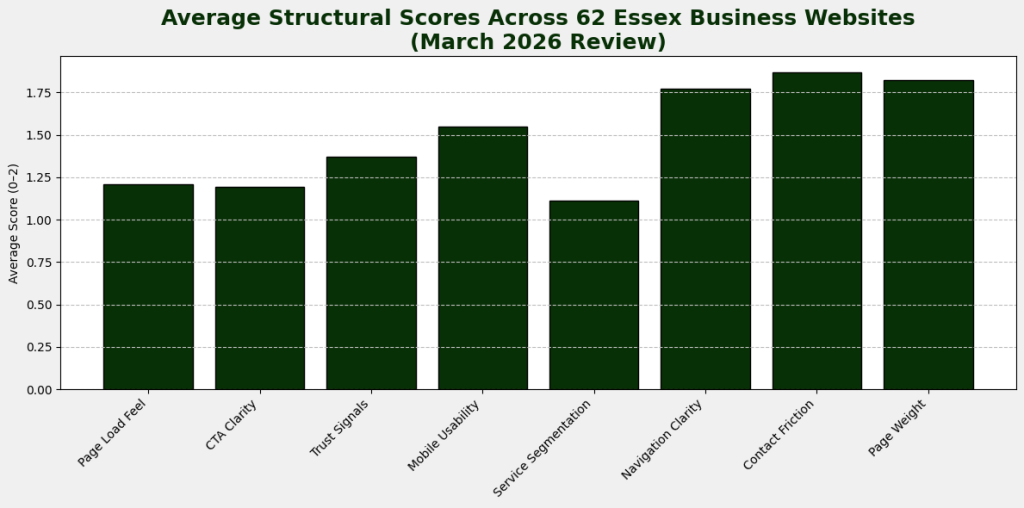
The chart summarises the average structural scores observed during the March 2026 review of 62 Essex business websites. Each factor was assessed using a simple 0-2 observational scale where 0 indicates poor implementation, 1 indicates mixed implementation and 2 indicates clear implementation. The results highlight recurring structural patterns across the sample rather than performance of any individual website.
Navigation clarity and contact accessibility scored highest across the sample, while service segmentation and clear calls to action showed the most inconsistency.
Data Disclaimer
The findings presented in this review reflect observable website characteristics at the time of analysis (02-05 March 2026). Website performance and structure may change as businesses update their sites, hosting environments, or content. This review was designed to identify structural patterns across the Essex local search landscape rather than evaluate or rank individual businesses.
Selection Criteria
Websites were selected from organic Google search results (desktop view) using location-modified queries across six sectors:
- Construction (Loft Conversions, Builders, Extensions)
- Cleaning Companies
- Wellness Clinics
- Dental Services
- Electricians
- Solicitors
Example queries included phrases such as “loft conversion Essex”, “dentist Chelmsford” and “solicitor Colchester”. Paid advertisements were excluded. Where possible, websites were drawn from first-page organic results. Duplicate domains were not counted.
Evaluation Criteria
Each website was reviewed against observable and measurable structural factors, including:
- Core Web Vitals indicators (where publicly testable)
- Mobile-first responsiveness and usability
- Page hierarchy and heading structure
- Technical SEO foundations (indexation signals, sitemap presence, crawlable navigation)
- Plugin weight and third-party script dependency (where detectable)
- Conversion clarity (calls to action, enquiry pathways)
- CMS platform identification where visible
This was not a design critique. It focused on structural performance and long-term maintainability indicators.
This scoring model was designed to provide a rapid structural benchmark rather than a full technical audit.
Limitations
The findings reflect observed performance patterns within the selected sample and should not be considered a statistically representative national study. Results may vary by hosting configuration, update frequency and content management practices after launch.
The purpose of this audit was to identify recurring structural themes within Essex’s local search landscape, not to rank or score individual businesses.
What to Look for in a Web Design Agency in Essex
Not all web design agencies in Essex build the same type of website.
Some prioritise fast delivery. Some prioritise visuals. Some build for long-term performance: site structure, speed, technical SEO and maintainability. That difference matters more than most businesses expect, because it affects rankings, enquiries and how soon you will need a rebuild.
If you want a practical way to assess an agency, use the sections below as your checklist.
Technical Foundations
Technical foundations decide whether a site stays fast, stable and easy to improve over time.
Core Web Vitals
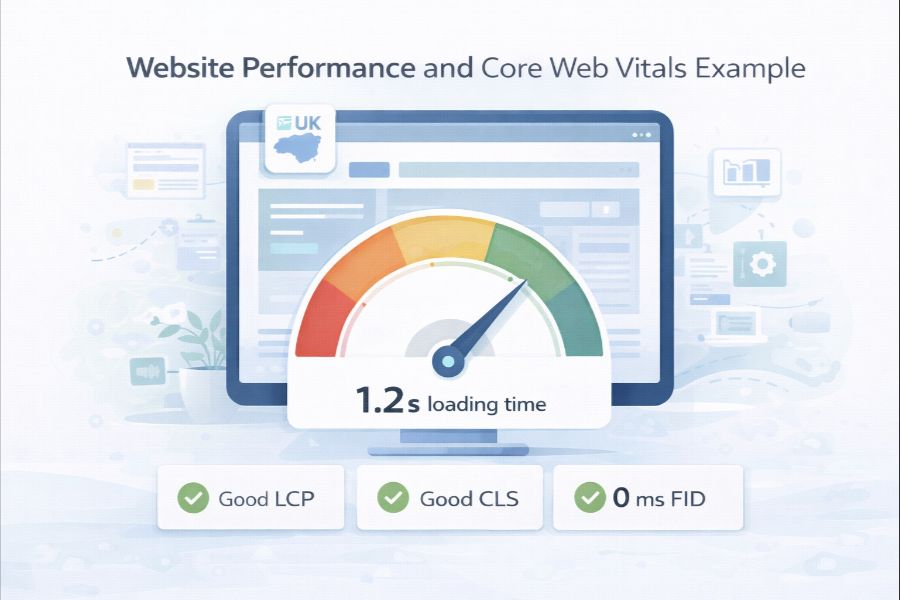
Core Web Vitals are performance signals that reflect loading speed, interactivity and layout stability. Lots of agencies mention them. Fewer design and build around them.
Look for evidence of:
- Controlled image sizes and modern formats
- Minimal third-party scripts
- Limited plugin weight
- Caching and asset compression done properly
Takeaway: If an agency cannot show before-and-after performance examples, ask how performance is measured and what ‘good’ looks like in numbers.
Note: Scores can vary by hosting, plugins and how content is added after launch.
Mobile-First Structure
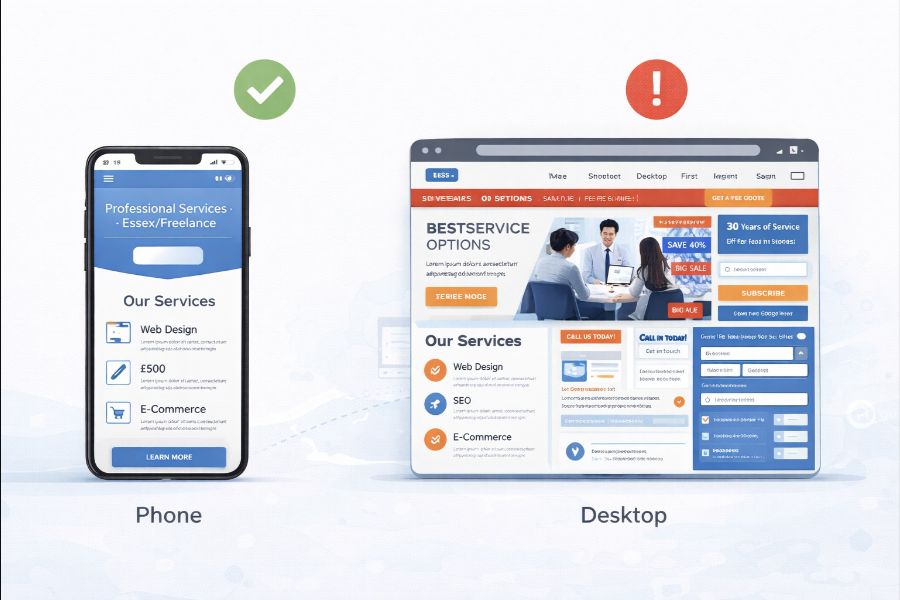
Most local searches happen on mobile. A mobile-first build is not “desktop shrunk down”. It is a structure designed for small screens from the start.
Signs it has been done properly:
- Clear service page groups
- Consistent URLs (not random page names)
- Internal links that make sense
- Headings that follow a logical hierarchy
Takeaway: Ask to view recent projects on a phone, not a desktop.
Note: Mobile performance can drop quickly if heavy sliders, videos, or tracking scripts are added later.
Clean Architecture
Clean architecture helps both Google and users understand what you do and where they should go next.
A structured site usually has:
- Clear service page groups
- Consistent URLs (not random page names)
- Internal links that make sense
- Headings that follow a logical hierarchy
Takeaway: If the navigation feels unclear, the site structure is usually unclear too.
Note: Larger sites need more planning around categories and page depth.
It is also worth recognising that not every agency offers the same specialism. Some focus primarily on branding and brand strategy, while others concentrate on website performance, technical SEO and user experience.
If your priority is establishing a complete brand identity before commissioning a website, a specialist branding agency such as Wavespace may be more appropriate. If your brand is already established and your focus is website performance, usability and search visibility, a web design agency with technical expertise is often a better fit.
Speed Optimisation
Speed is rarely “fixed at the end”. It is influenced by choices made early.
Ask whether speed is considered during:
- Theme or framework choice
- Page builder selection
- Hosting setup
- Image handling
- Script loading strategy
Takeaway: If an agency relies on a heavy builder for everything, expect more optimisation work later.
Note: Ecommerce and booking systems can add weight, so the build approach matters even more.
SEO Integration
SEO should not be bolted on after launch. A good agency builds the foundations in the site structure.
Built-In Technical SEO
At minimum, a build should include:
- Crawlable navigation (not hidden behind scripts)
- Clean indexing settings
- XML sitemap setup
- Proper canonicals where needed
- A sensible approach to meta titles and descriptions
Takeaway: Ask what is included as standard and what is treated as an add-on.
Note: Multi-location or service-area sites need extra care with structure and duplication.
Structured Headings
Headings are not just styling. They help define page meaning.
A strong page typically has:
- One clear H1
- Sections organised with H2s and H3s
- Keywords used naturally (not repeated mechanically)
Takeaway: If headings are used purely for design, the content structure is usually weak.
Note: Long service pages benefit from more sectioning, but it must stay logical.
Crawlable Navigation
Creative navigation can look modern but reduce clarity.
In competitive local markets, clear service naming and predictable menus often perform better because users and search engines understand them quickly.
Takeaway: If you cannot find a key service in one click, neither can most users.
Note: Larger businesses may need mega-menus, but they still need clarity.
Portfolio Quality
Portfolios can be misleading if you only judge visuals.
Instead, check whether the work demonstrates performance and conversion thinking:
- Does it load quickly on mobile?
- Are services easy to find and understand?
- Is there a clear next step (call, form, book)?
- Are case studies specific (not just pretty screenshots)?
An agency that works across construction, dental, legal and wellness often shows stronger structure, because templates rarely fit all of those sectors well.
Takeaway: Ask for two examples that are similar to your business type and goals.
Note: Some industries need compliance, accessibility, or trust signals that change page structure.
Platform Transparency
You should know what your website is built on and why.
WordPress vs Shopify vs Custom
A sensible agency will explain the trade-offs:
- WordPress: Flexible, widely supported, strong SEO control
- Shopify: Strong ecommerce system, faster setup for online selling
- Custom: More control, but higher maintenance expectations
Takeaway: If the platform choice is vague, you may be buying into lock-in without realising.
Note: Integrations (CRM, booking, payments) often influence the best platform choice.
Avoid Lock-In Systems
Ask direct questions:
- Do I own the website and admin access after launch?
- Can I move hosting if I want to?
- Is the CMS widely supported in the UK?
- What happens if we stop working together?
Takeaway: A confident agency will answer these clearly and in writing.
Note: Some managed platforms are fine, but the exit path should still be transparent.
Questions to Ask Before Hiring a Web Design Agency in Essex
Choosing a web design agency in Essex is easier when you ask direct questions early. Clear answers reduce misunderstandings later and they usually reveal whether an agency builds for long-term performance or just quick delivery.
Use this checklist during calls or email threads and keep the answers in writing.
Ownership & Access
- Who owns the website after launch, including the domain and files?
- Will I receive full admin access (not a restricted login)?
- Can I move the website to another host if I choose to?
- What happens if we stop working together?
Why this matters: If ownership or access is unclear, you can end up locked into ongoing fees or delays when you need changes.
Build Method & Performance
- How do you approach Core Web Vitals during the build, not after?
- What do you do to keep pages lightweight (images, scripts, fonts)?
- Do you use a page builder and if so, which one and why?
- How many plugins are typical on a standard site and what are they for?
- Can you show a recent site’s mobile speed results as an example?
Why this matters: Speed problems are often created by build choices, not “bad hosting” alone. A good agency can explain the trade-offs clearly.
SEO Integration
- What technical SEO is included as standard (sitemaps, indexing, canonicals)?
- How are service pages structured for search and for users?
- How do you handle headings and internal links across the site?
- Will you set up analytics and Search Console access in my name?
Why this matters: If SEO is treated as an add-on, the site may launch without a proper foundation for ranking.
Platform Choice & Scalability
- Why are you recommending this platform for my business goals?
- What happens if I want to add ecommerce, booking, or new locations later?
- Is the CMS widely supported in the UK, or is it proprietary?
- How do you prevent the site becoming hard to maintain after 18-24 months?
Why this matters: Platform decisions affect what your site can become, not just how it looks at launch.
Content, Editing & Day-To-Day Control
- Who adds the initial content and who edits it after launch?
- Will I be able to update text and images without breaking layouts?
- Do you provide a simple handover guide or walkthrough?
Why this matters: If updating the site feels risky, your content will stagnate and performance usually declines over time.
Support, Maintenance & Security
- What is included in post-launch support and what counts as extra work?
- Who handles updates, backups and security monitoring?
- What is the typical response time if something breaks?
- Do you offer a maintenance plan and is it optional?
Why this matters: Many issues appear after launch, not before it. Stable websites are maintained, not “finished”.
If an agency answers these clearly, you’re usually dealing with a structured operator. If the answers are vague, defensive, or inconsistent, that is useful information too.
Essex-Specific Considerations
Choosing a web design agency in Essex is not the same as choosing one in a low-competition area. Local search is crowded in places like Chelmsford, Colchester, Southend and Brentwood and small structural issues can become ranking issues fast, especially in competitive sectors like solicitors and dental services.
During our structured review of 62 Essex small business websites (02-05 March 2026), one pattern showed up repeatedly: many sites looked “fine” at a glance, but their local visibility was limited by page structure, unclear service targeting, or weak integration with Google Business signals. The design was not always the problem. The architecture was.
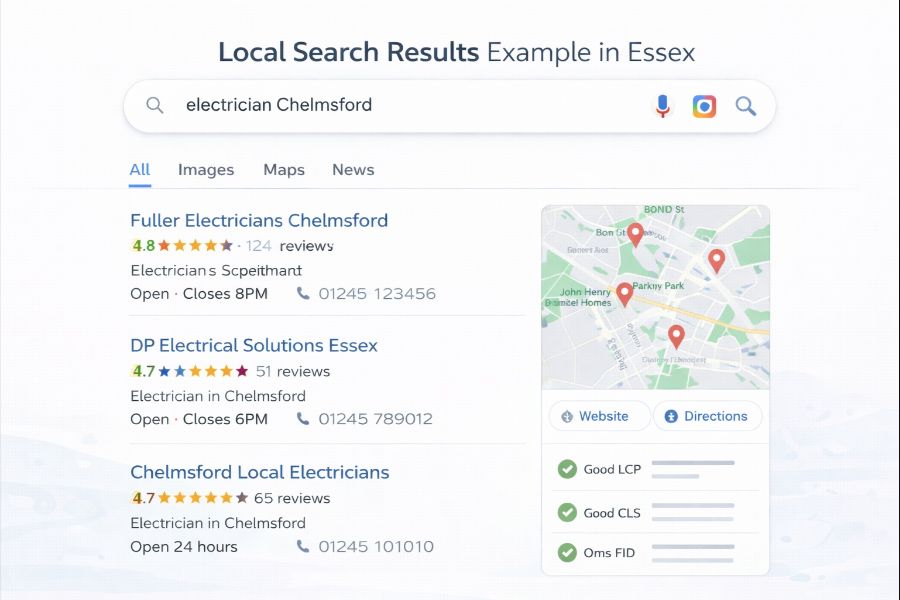
What Web Design In Essex Needs To Account For
- Clear service targeting that matches local searches
- Logical page structure for services and locations
- Consistent NAP details (name, address, phone) across the website
- Google Business Profile alignment (reviews, categories, service areas)
- Internal linking that connects related services and high-intent pages
Location Pages Need A Reason To Exist
A common mistake is creating multiple town pages that say the same thing with the town name swapped. That can dilute relevance, create thin content and confuse both users and search engines.
If location pages are used, they should exist for a clear reason, such as:
- Different service coverage or response areas
- Different teams or premises
- Different buyer intent (for example emergency work vs planned work)
Variability note: Some Essex businesses do not need town pages at all. A strong service structure and a well-managed Google Business Profile can outperform a forced location strategy.
Competition Varies By Sector
Local competition is not evenly distributed. In Essex, the bar tends to be higher for:
- Solicitors (Conveyancing, Family Law, Wills)
- Dental Services (Implants, Orthodontics, Private Clinics)
Trades and cleaning businesses can still be competitive, but results are often more sensitive to reviews, responsiveness and clarity of service area coverage.
Practical takeaway: Ask an agency how they adapt structure depending on your industry, not just how they design the homepage.
User Expectations In Essex Are Practical
People comparing providers in Essex often want immediate clarity:
- What you do
- Where you operate
- How to contact you
- Proof you are credible (reviews, accreditations, case examples)
If those elements are buried, enquiries drop quietly. Not because the business is bad, but because the next option is easier to trust in 30 seconds.
For businesses investing in web design Essex providers, the local context matters. The right agency should be able to explain how structure, speed, technical SEO and Google Business alignment work together, rather than treating local visibility as something you “add later”.
Red Flags to Watch Out For
Most website problems do not start with a dramatic failure. They start with small gaps: unclear scope, vague ownership, or a build process that prioritises speed of launch over long-term performance.
During our review of Essex small business websites (02-05 March 2026), a common theme was not “bad design”. It was weak structure: slow pages, unclear service targeting and sites that were difficult to maintain without constant agency involvement.
Here are the red flags worth taking seriously.
Very Low Pricing With Vague Scope
Low pricing is not automatically a problem. Vague scope is.
If a proposal does not clearly state:
- Page count or page types
- What is included for technical SEO
- Performance and speed approach
- Content upload responsibility
- Post-launch support and fix period
You may be comparing an incomplete quote with a complete one.
Takeaway: Ask for a written scope that includes deliverables, assumptions and exclusions.
Note: Small brochure sites can cost less, but scope should still be explicit.
Performance Is Not Measured Or Discussed
If an agency does not talk about speed, Core Web Vitals, or build weight, the process is often visual-first.
That may still produce a “nice looking” site, but it increases the risk of:
- Slow mobile load times
- Plugin bloat
- Poor ranking consistency
- Higher costs to optimise later
Takeaway: Ask what they measure before launch and what “good” looks like in numbers.
Note: Ecommerce, booking systems and heavy tracking can affect scores, so build choices matter even more.
You Do Not Own The Key Accounts
Some businesses only discover after launch that:
- Analytics is not in their name
- Search Console access is missing
- The domain is held by the agency
- Admin rights are restricted
That becomes a problem the first time you need a change quickly.
Takeaway: Ensure your business email owns the domain, hosting, Analytics and Search Console.
Note: Agencies can manage access, but ownership should remain yours.
Vague Answers About Platform, Plugins, Or Editing Control
If explanations are vague or defensive, pay attention. A structured agency should be able to explain:
- Why a platform was chosen
- Whether a page builder is used (and why)
- Rough plugin count and purpose
- How you edit content without breaking layouts
- How the site will be maintained over time
Takeaway: Ask how content updates work in practice after launch.
Note: Some platforms are simpler than others, but clarity should exist regardless.
No Clear Handover Or Post-Launch Plan
A common issue is treating launch day as the finish line. In reality, websites need:
- Updates
- Backups
- Security monitoring
- Small iterations based on enquiry behaviour
If there is no handover process, the site can become fragile quickly.
Takeaway: Ask what happens in the first 30 days after launch and what support is included.
Note: Some businesses need ongoing support, others just need a clean handover – either is fine if it is defined.
Over-Promising SEO Results
Be cautious of guaranteed rankings or fixed traffic promises. Search performance depends on competition,
authority, content quality and ongoing improvements. A responsible agency will talk about:
- Dependencies
- Timeframes
- Limitations
- What is within their control
Takeaway: Treat guaranteed rankings with caution; outcomes depend on competition, authority and ongoing improvements.
Note: Local results can improve quickly in some niches, but outcomes are never fully controllable.
Pricing Expectations in Essex
Pricing for web design in Essex varies because websites are not all the same job. The biggest cost drivers are usually scope, content volume, platform choice and how much performance and technical SEO work is included during the build.
The ranges below are typical for UK service businesses, but they are not fixed prices. Final cost depends on requirements, timelines and what is included after launch.
Brochure-Style Service Websites
Typically 5 to 10 core pages, basic contact capture and a simple content structure.
Approximate range: £1,500 – £4,000
This bracket often suits smaller trades and local services, but quality varies widely. Some builds are genuinely lean and well-structured. Others are template-led with limited performance work.
Takeaway: Ask what is included for speed, technical SEO and mobile structure, not just design.
Structured Service Business Websites
Typically 10 to 25 pages, clear service segmentation, stronger technical SEO foundations and conversion-focused page flow.
Approximate range: £4,000 – £9,000
This is where many established Essex businesses land when they want a website that ranks reliably and does not feel “patched together” after 18 to 24 months.
Takeaway: Ask how the site architecture is planned before design begins.
Ecommerce Or Functionality-Heavy Websites
Online sales, booking systems, memberships, gated content, or third-party integrations.
Approximate range: £6,000 – £15,000+
Costs usually increase with:
- Payments and checkout complexity
- Booking logic or availability rules
- CRM or API integrations
- Custom features beyond the core platform
- Ongoing maintenance and support requirements
Takeaway: For complex sites, build method matters more than visual style. Poor structure becomes expensive later.
What Influences Cost Most?
Pricing differences are usually driven by:
- Page volume and content depth
- Platform choice and build approach
- Technical SEO inclusion
- Performance engineering requirements
- Integrations and custom functionality
- Post-launch support scope
Lower quotes often reflect reduced scope rather than “better value”. That does not mean higher cost automatically equals higher quality. It means you should compare like-for-like deliverables and make sure exclusions are clear.
Limitation: These ranges are indicative and should be treated as guidance, not a quote.
Comparing Delivery Models You Will See In Essex
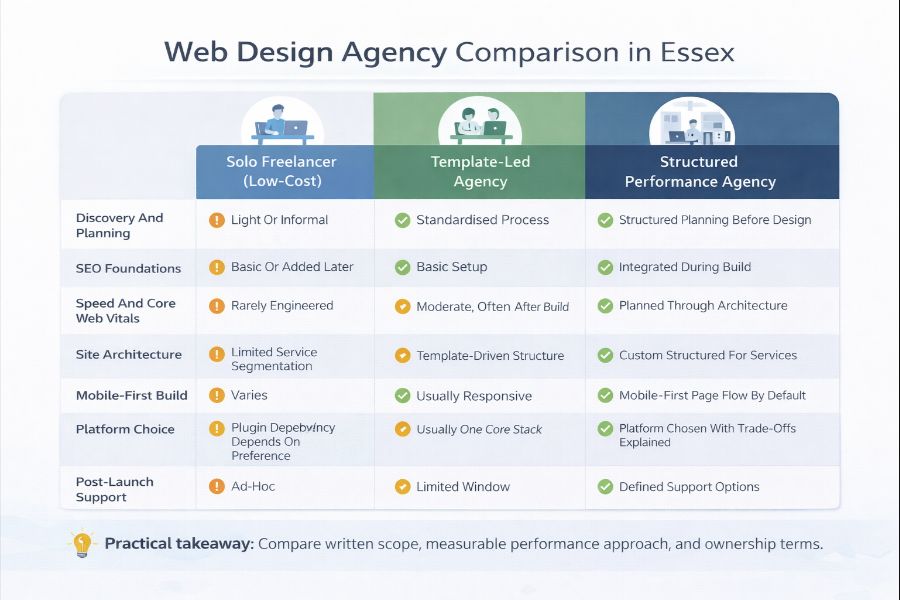
Most Essex businesses end up comparing a similar mix of providers. The names vary, but the delivery models are usually consistent: solo freelancers, template-led agencies and structured performance-led agencies.
The differences are typically methodological rather than visual.
Factor | Solo Freelancer (Low-Cost) | Template-Led Agency | Structured Performance Agency |
Discovery And Planning | Light Or Informal | Standardised Process | Structured Planning Before Design |
SEO Foundations | Basic Or Added Later | Basic Setup | Integrated During Build |
Speed And Core Web Vitals | Rarely Engineered | Moderate, Often After Build | Planned Through Architecture |
Site Architecture | Limited Service Segmentation | Template-Driven Structure | Custom Structured For Services |
Mobile-First Build | Varies | Usually Responsive | Mobile-First Page Flow By Default |
Platform Choice | Depends On Preference | Usually One Core Stack | Platform Chosen With Trade-Offs Explained |
Plugin Dependency | Often Higher | Moderate | Controlled And Purpose-Driven |
Measurement Setup | Varies | Usually Basic | Analytics And Search Console Ownership Planned |
Editing And Day-To-Day Control | Can Be Unclear | Usually Simple | Clear Editing Approach And Handover |
Long-Term Maintainability | Can Become Fragile | Moderate | Engineered For Durability |
Post-Launch Support | Ad-Hoc | Limited Window | Defined Support Options |
Ownership Clarity | Varies | Usually Clear | Clearly Defined From Start |
Important Context
This comparison reflects common patterns seen in the Essex market, not a judgement of any specific provider. Individual agencies and freelancers can sit outside these patterns.
Takeaway: Compare written scope, measurable performance approach and ownership terms, not just visuals.
Key Findings (For Media & Sharing)
Based on our structured review of 62 Essex small business websites (02-05 March 2026):
- Modern design often masked weak structure and poor page hierarchy
- Mobile speed issues were common across construction, dental, legal and wellness sites
- Technical SEO was frequently treated as an add-on, not a build standard
- Plugin weight and third-party scripts were regular causes of slow pages
- Ownership of analytics, Search Console and domains was sometimes unclear
Study Expansion Plan
This March 2026 review analysed 62 Essex small business websites across six sectors. The intention is to expand this structured audit into a broader UK benchmark study in 2027, increasing sample size and geographic coverage to compare local performance patterns at a national level.
Future expansions will follow the same methodology principles: transparent sampling, observable technical criteria and clearly stated limitations.
Implications for Essex and UK Businesses
For Essex businesses investing in web design Essex providers, the findings suggest that structural quality is often more important than visual refresh cycles. Many of the issues observed were not aesthetic problems. They were architectural: unclear service segmentation, mobile performance weaknesses and technical SEO gaps introduced during development rather than marketing.
Similar patterns were identified in our broader Essex website performance research.
In practical terms, this means:
- Build decisions influence visibility more than post-launch tweaks
- Mobile performance cannot be treated as optional
- Clear ownership of analytics and domain assets reduces long-term risk
- Service structure matters more than homepage design
While this study focused on web design in Essex, the underlying patterns are not geographically unique. Similar structural weaknesses are common across UK local service markets where competition has increased but build standards vary widely.
Location still matters. Proximity signals, Google Business alignment and clear service targeting remain essential for local rankings. However, beyond geography, disciplined architecture, speed engineering and transparent ownership practices tend to separate short-term builds from durable digital assets.
For established service businesses, the strategic takeaway is simple: treat your website as infrastructure, not decoration. In competitive counties like Essex, infrastructure tends to outperform aesthetics over time.
What This Means If You’re Considering A Website Build
If you are planning a new website or a rebuild in 2026, the decision is less about choosing “a designer” and more about choosing how the site will be built and maintained.
Before you compare quotes, get clear on what you actually need the website to do over the next 12-24 months:
- Win enquiries consistently from local search
- Support trust quickly (reviews, proof, clarity)
- Load fast on mobile without constant fixes
- Stay easy to update as services evolve
Many Essex businesses only confront these requirements after launch, when limitations show up as slow pages, unclear service targeting, or a site that is awkward to expand without breaking structure.
A structured build approach usually means more upfront thinking: service mapping, page hierarchy planning, mobile-first flow and performance considerations before visual styling is finalised. It can feel slower at the start, but it often reduces long-term friction and prevents “patch-and-repair” websites.
This does not mean every business needs a large website. Plenty of Essex companies do well with lean builds. The difference is whether the structure is intentional.
If you are shortlisting agencies, compare them on:
- Method and deliverables over visual style
- Ownership and account access over convenience
- Maintainability over launch speed
- Measurable performance approach over promises
A website tends to reflect the thinking behind it. In a competitive county like Essex, structured thinking usually compounds over time.
Conclusion
Choosing a web design agency in Essex is ultimately a structural decision, not just a creative one. Visual design affects first impressions, but architecture, speed and technical foundations shape rankings, usability and long-term maintainability.
In competitive Essex markets, small structural advantages often compound over time. Businesses that prioritise clarity, ownership and measurable build standards typically reduce the risk of expensive rebuild cycles.
If you want a practical benchmark for what “built properly” looks like, explore our Web Design Essex page and compare it against the checklist in this guide. The right decision now usually reduces friction later.